

Beyond the Cuff: The History & Future of Blood Pressure Monitoring
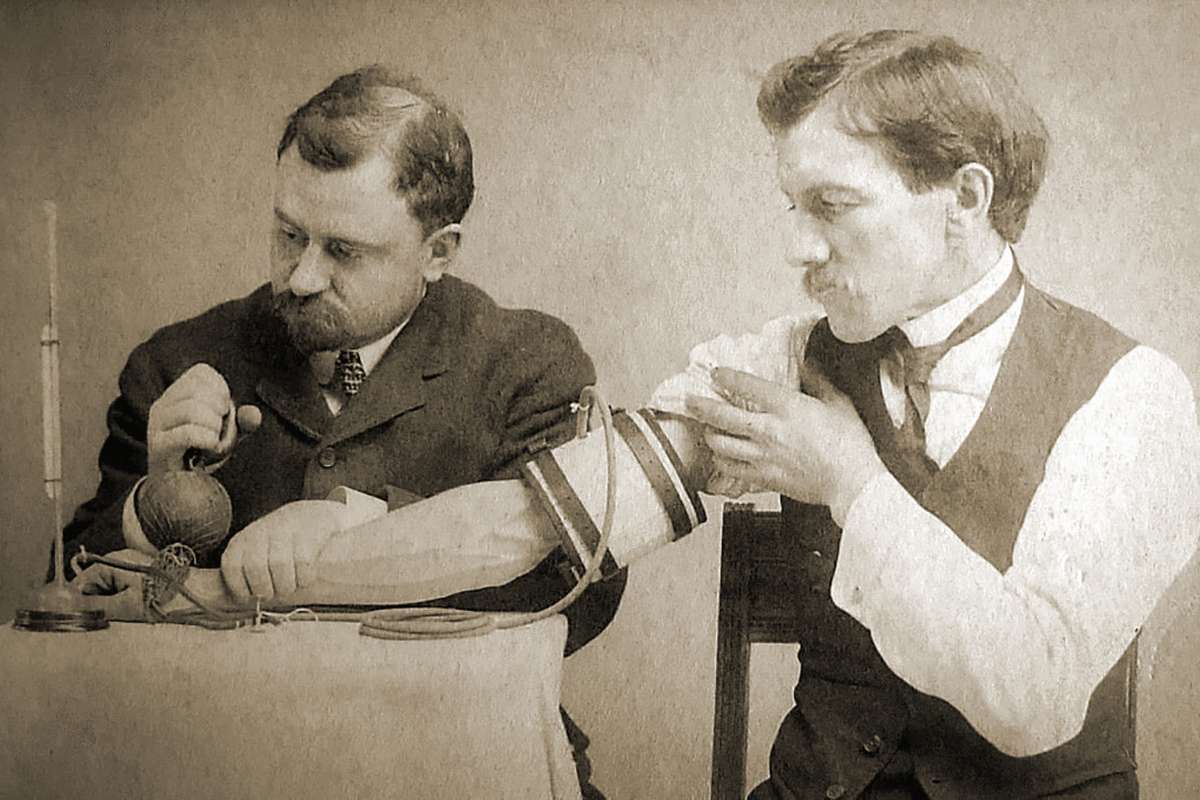
Compared with smartphones, social media, televisions, and travel, the evolution of blood pressure measurement has moved at a snail’s pace over the past few decades.
You could even argue it hasn’t moved at all.
But why do we still rely on the dated and rather cumbersome blood pressure cuff? And can we expect any progress soon for easier, more accurate measurements?
Below, you’ll find a summary of the history of blood pressure theory and tools up until today, as well as a bold prediction of what the future holds for those with hypertension.
(PS Feel free to scroll to the end if you want to cheat and see the prediction immediately!)
The History of Blood Pressure: A Timeline From 200 AD to The 2020s
AD 200: The Blood Pressure Beginnings in Ancient Greece

We begin our tour of the past with Galen, a Greek philosopher, and physician in the Roman Empire. He advanced on Hippocrates’ observation that arteries ceased to bleed at the point of death.
Galen put forward the theory of a circulatory system with arteries containing “pneuma.” What’s that? We hear you ask. Pneuma was thought of as a life force pushed around the body by the heart.
The Early 1600s: A Blood Pressure Controversy
English physician, William Harvey, went against Galen by proclaiming that the heart does not give an endless supply of blood. Instead, a limited amount of blood can move around the body in one direction.
Harvey’s breakthrough caused quite a stir. Reason being? Bloodletting – a now abandoned blood removal treatment hoped to filter out impurities and cure conditions – was a common medical practice at the time. Under Harvey’s assumption, there was no longer an infinite amount of blood for a sick individual to recover, so bloodletting was now viewed as a risky therapy.

1711: The First Documented Measurement of Blood Pressure
Reverend Stephen Hales is credited with the first known instance of blood pressure measurement. It was far from ethical, in hindsight.

The method? Hales placed a glass tube into the artery of a horse (as well as smaller animals). Seeing how the blood rose and fell within the tube, he established that this must be due to changes in blood pressure.
The Birth of The Blood Pressure Cuff in The 1800s
An Austrian physician, Dr. von Basch, invented the sphygmomanometer (also known as the blood pressure monitor) in 1881.
Although celebrated as the first non-invasive way to measure human blood pressure, it was also complex. The device included a rubber bulb filled with water to manipulate blood flow in the artery and a mercury column to record the reading.
In the late 1800s, the Riva-Rocci device was adapted by a doctor named Nikolai Korotkoff. After this adaptation, the device could fit around the arm and become the blood pressure cuff design we still see today.

1905 marked the next stage of understanding. Korotkoff was able to determine the difference between systolic and diastolic blood pressure. This was done by recording five different sounds (the Korotkoff sounds) in the arteries as the heart contracted and refilled with blood. A big breakthrough.
And Then… Nothing?
The blood pressure history timeline above shows a flurry of new knowledge and possibilities following the progress made in the 1600s, 1700s, and 1800s. But then everything seems to grind to a halt.

It’s strange. Especially when we consider how essential facets of health, such as exercise, nutrition, and sleep, have developed rapidly over the past decade. Daily step counters, calorie-tracking apps, and sleep analytics are now available to most. The Hilo Band fits right into this trend. It now includes a built-in step counter that automatically tracks your daily activity and shows how it connects to your blood pressure readings. Yet, more advanced blood pressure measures have not appeared on the market.
Until now…
Embracing Technology and Insights: The Modern-Day Invention For Measuring Blood Pressure
Do either you or a loved one have hypertension?
If so, you’ll know the limitations of the standard blood pressure cuff method all too well:
- Awkward to carry around with you when you’re away from home
- Fluctuating readings caused by hard-to-control factors such as cuff placement, movement, stress, anxiety, and other environmental factors
- Lack of night-time measurements while you’re asleep. The Hilo Band addresses this directly. It now tracks your sleep duration. This helps catch issues like nocturnal hypertension that traditional methods miss.
- Time-consuming to attach the cuff and take it off again several times a day
The good news is that you no longer need to put up with these inconveniences!
You can now measure your blood pressure 24/7, no matter where you are, thanks to Hilo’s “wear it and forget it” technology and mobile app. Finally, there’s a better way to manage and monitor your blood pressure.

With over 50 million measurements to date – and having been clinically validated for accuracy by over 20 peer-reviewed papers – Hilo Band is ushering in a new era in the future of blood pressure tracking.
The invention of the blood pressure cuff has taken us so far. But it’s time to give people with hypertension more control, data, and peace of mind that their blood pressure is moving in the right direction.
Learn more about Hilo today. New insights about your heart health await.
Also, we recommend you stay in the loop with all things blood pressure by subscribing to the Hilo email list below. Don’t wait – join the thousands of subscribers that are taking steps to improve their heart health.
Join our community of health-conscious individuals and stay informed about the best practices for monitoring your blood pressure. Sign up for our newsletter today!
Disclaimer: The information provided in this article is for general information purposes only and is not intended to be a substitute for professional medical advice. Always consult your physician or qualified healthcare provider for any questions related to a medical condition. The author and publisher are not liable for any harm or damage resulting from the use or misuse of the information in this article.
Sources:
William Harvey and the discovery of the circulation of the blood, September 21, 2009 – https://www.ncbi.nlm.nih.gov/articles-PMC2776239
Stephen Hales and the measurement of blood pressure, December 8, 1994 – https://pubmed.ncbi.nlm.nih.gov/7884783
Sphygmomanometer, October 14, 2022 – https://en.wikipedia.org/sphygmomanometer
Korotkoff Sounds, March 18, 2020 – https://www.ausmed.co.uk/explainers-korotkoff-sounds
Leer más
Una guía clara sobre cómo el sueño influye en la presión arterial y la salud del corazón, con datos recientes y pasos simples para mejorar su bienestar.

La hipertensión arterial a edades tempranas puede aumentar el riesgo de desarrollar problemas de salud graves, como accidente cerebrovascular e infarto de miocardio, en etapas posteriores de la vida.

Para mantener la presión arterial dentro de un rango saludable puede ser útil consumir alimentos ricos en nutrientes y controlar de forma continuada la presión arterial.

Sobre el revisor médico
Dr Jay Shah
MD, FACC · Asesor médico y revisor