

Blood pressure fluctuations: What can cause them and what do they mean?

While we often think of blood pressure (BP) as a single number, likely because during a medical check-up only one data point is collected, it’s actually continually changing. These variations throughout the day and night are in-line with your circadian rhythm, or ‘internal body clock’.
In a healthy individual, BP will start to rise a few hours before waking, continuing upward until around midday, which is when it’s at its highest. It then tends to fall during the late afternoon into the evening, and should be at its lowest overnight – between 10 and 20% lower than your daytime average. If your BP doesn’t reduce during the night, you could be a ‘non-dipper’, a profile sometimes associated with organ damage, as well as poorer renal and cardiovascular outcomes. Another related medical condition is ‘nocturnal hypertension’, where blood pressure is elevated overnight and, defined by the European diagnostic thresholds for nocturnal hypertension as being at or over 120/70 mmHg. This is lower than a daytime value for hypertension of 140/90 mmHg because BP should dip overnight.
However, while it’s been noted that daily fluctuations in BP are normal, there are several instances where BP can change by a larger degree than may be expected. We’ll list and explain them below.
If you are concerned about your blood pressure, always speak with a medical professional.
10 times your BP may fluctuate outside your natural rhythm
- White coat syndrome
White coat syndrome is a condition where your blood pressure is raised due to the stress of being in a medical setting, pushing your measurement higher than it would be if you took it at home. This is not to be confused with white coat hypertension, where your blood pressure readings are over 140/90 mmHg in the clinic – a measurement classified as hypertensive – but lower than 140/90mmHg at home. Both white coat syndrome and white coat hypertension are well-known medical conditions, affecting between 15 and 30% of those with elevated BP at the doctor’s.
- Masked hypertension
Masked hypertension is often described as the opposite of white coat syndrome or hypertension, with measurements in the clinic giving values lower than those at home. Studies have suggested that elderly, male, patients with large BP variability are most likely to suffer from masked hypertension. In other patient populations, those with mental stress at home or work may have hypertensive BP outside the clinic, but normal numbers once away from the stressor. Other profiles with a higher risk are smokers or heavy drinkers, as well as those who are sedentary and obese.
- Temperature
The weather can have an impact upon blood pressure. On average, your BP is likely to be lower in the summer than it is in winter. This difference is due to something called ‘vasodilation’. Higher temperatures cause blood vessels at your skin’s surface, called capillaries, to dilate so that blood flow can be diverted to these vessels to help dissipate excess heat into the surrounding environment. This means it’s easier to pump blood around the body as there is less resistance, thus reducing blood pressure.
Cold weather causes the opposite. Vasoconstriction is a protective biological feature designed to ensure that your body doesn’t lose too much heat by keeping blood close to your central organs instead of the skin surface. However, constricted blood vessels can result in higher blood pressure as your heart meets more resistance when pumping your blood.
- Exercise
It’s normal for blood pressure to temporarily rise during physical exertion. Systolic BP tends to exhibit a linear increase, corresponding to the increased metabolic demands of the body and higher cardiac output (reflected in the rising heart rate), whereas diastolic BP tends to stay more stable. However, working out regularly leads to lower blood pressure overall, which is beneficial to your health. In addition to lowering BP, regular exercise also reduces risk of heart disease, diabetes, obesity, kidney failure and osteoporosis, as well as improving mental clarity and lifting your mood.
- A full bladder
Having a full bladder can temporarily increase your BP. In fact, it can cause your systolic BP (the larger number) to go up by 10 to 15 mmHg! This means that it’s important to measure BP when you don’t need to pee!
- Stress
It’s well known that stress can have a significant impact upon your health. However, not all forms of stress are created equal. Acute (short-term) stress, lasting from minutes to hours, can prove useful – for example keeping your body awake and alert, allowing you to focus for longer. But both episodic acute (where acute stress is experienced on a regular basis) and chronic, or long-term, stress can have a detrimental impact on your overall well-being.
- Over-the-counter cold remedies
Over-the-counter (OTC) cold remedies contain decongestants such as pseudoephedrine, ephedrine, phenylephrine, naphazoline, and oxymetazoline. These can contribute to temporary increases in blood pressure, which may be dangerous for people with hypertension. This is because they narrow blood vessels, making it harder for blood to flow through them, resulting in increased resistance and therefore increased BP.
- Caffeine
The relationship between coffee and blood pressure is complex. While caffeine can cause a temporary spike in blood pressure, the increase may be short-lived.
- Smoking
Smoking raises blood pressure through several mechanisms. The nicotine increases your heart rate and causes arteries to vasoconstrict. Toxins inside cigarette smoke damage blood vessels and smoking may lead to atherosclerosis, the process whereby fat is laid down in your arteries’ walls. In conjunction with this, smoking also increases the likelihood of clot formation. This raises your overall risk of cardiovascular disease.
- Menstrual cycle
There’s a connection between your menstrual cycle and blood pressure, as well as connections between BP and menstrual symptoms such as heavy bleeding, irregular periods, and PMS. Furthermore, the use of oestrogen-based contraceptives can cause a rise in blood pressure over time in a few cases. For more details, head to our article ‘How does your menstrual cycle influence your blood pressure?’.
The Hilo Band: easy insight into your BP behaviour
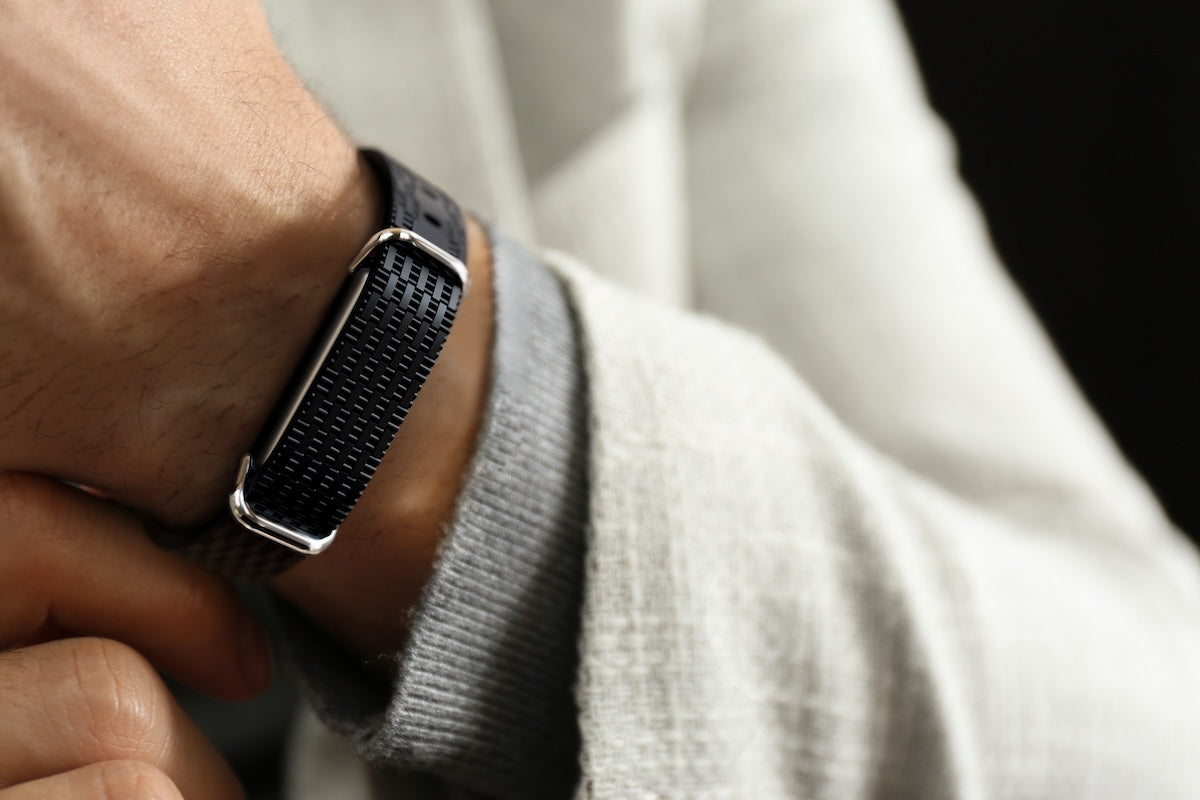
The Hilo Band has been specifically designed to allow you to see the patterns of your blood pressure day and night – revealing data that otherwise remains hidden. It works by using photoplethysmography, or PPG, which involves shining green light into the skin and measuring the light reflected back. Changes in blood volume with each heartbeat affect the amount of light reflected, allowing the sensor to capture the pulse’s wave. The proprietary algorithm then analyses these optical signals, converting them into blood pressure measurements that are presented in an easy-to-read graph within the Hilo App.
Set-up couldn’t be easier. Once you’ve received your product, all you need to do is calibrate the band with the inflatable Hilo Cuff (which is provided) once a day for four days during your first week of use. This is important for accuracy, enabling the device to give you your absolute blood pressure values in mmHg. After this initial onboarding period, calibration is only required once per month, making sure accuracy isn’t compromised over time.
Once set-up, the Hilo Band takes measurements whenever the in-built accelerator notes that you’ve been still for at least 5 minutes. It then gives an average measurement over a 2-hour period, as averaging is the standard practice that both physicians and hypertension guidelines recommend.
Rest assured, the Hilo Band’s underlying technology has been rigorously tested in multiple clinical studies across a broad range of people. It’s also been endorsed by leading hypertension experts, has been granted the CE Mark as a Class IIa medical device and FDA approval.
The information in this article is intended for educational purposes only and does not replace medical advice. If you suspect hypertension or are worried about your blood pressure, speak to your doctor. They can advise on the best way to effectively manage it.
Sources
H.-J. Choi (2012). Blood Pressure Variability and Its Management in Hypertensive Patients. Korean J. Fam. Med., 33, 330. https://doi.org/10.4082/kjfm.2012.33.6.330
J. Huart, A. Pursue, J.-P. Lengelé et al. (2023). Pathophysiology of the Nondipping Blood Pressure Pattern. Hypertension, 80, 719. https://doi.org/10.1161/HYPERTENSIONAHA.122.19996
A Shot in the Dark: The Importance of Nocturnal Hypertension Detection. Hilo. https://hilo.com/en-gb/blogs/art/nocturnal-hypertension (Accessed May 2026)
B. Williams, G. Mancia, W. Spiering et al. (2018). 2018 ESC/ESH Guidelines for the management of arterial hypertension. The Task Force for the management of arterial hypertension of the European Society of Cardiology and the European Society of Hypertension
J. Hypertens., 36, 1953. https://doi.org/10.1097/HJH.0000000000001940
White Coat Syndrome. Cleveland Clinic. https://my.clevelandclinic.org/health/diseases/23989-white-coat-syndrome (Accessed May 2026)
G. Nuredini, A. Saunders, C. Rajkumar et al. (2020). Current status of white coat hypertension: where are we? Ther. Adv. Cardiovasc. Dis., 14, 1. https://doi.org/10.1177/1753944720931637
S. S. Franklin, L. Thijs, T. W. Hansen et al. (2013). White-Coat Hypertension: New Insights From Recent Studies. Hypertension, 62, 982. https://doi.org/10.1161/HYPERTENSIONAHA.113.01275
C. Cacciolati, C. Tzourio, O. Hanon (2012). Blood Pressure Variability in Elderly Persons With White-Coat and Masked Hypertension Compared to Those With Normotension and Sustained Hypertension. Am. J. Hypertens., 26, 367. https://doi.org/10.1093/ajh/hps054
P. A. Landsbergis, M. Dobson, G. Koutsouras et al. (2013). Job Strain and Ambulatory Blood Pressure: A Meta-Analysis and Systematic Review. Am. J. Public Health, 103, e61. https://doi.org/10.2105/AJPH.2012.301153
M. Seki, R. Inoue, T. Ohkubo et al. (2010). Association of environmental tobacco smoke exposure with elevated home blood pressure in Japanese women: the Ohasama study. J. Hypertens., 28, 1814. https://doi.org/10.1097/HJH.0b013e32833a3911
T. Ohira, T. Tanigawa, M. Tabata et al. (2008). Effects of Habitual Alcohol Intake on Ambulatory Blood Pressure, Heart Rate, and Its Variability Among Japanese Men. Hypertension, 53, 13. https://doi.org/10.1161/HYPERTENSIONAHA.108.114835
M. G. Schultz, J. L. Hare, T. H. Marwick et al. (2011). Masked hypertension is “unmasked” by low-intensity exercise blood pressure. Blood Pressure, 20, 284. https://doi.org/10.3109/08037051.2011.566251
Blood pressure: Is it affected by cold weather? Mayo Clinic. https://www.mayoclinic.org/diseases-conditions/high-blood-pressure/expert-answers/blood-pressure/faq-20058250 (Accessed May 2026)
Vasodilation. Cleveland Clinic. https://my.clevelandclinic.org/health/diseases/23352-vasodilation (Accessed May 2026)
Vasoconstriction. Medline Plus. https://medlineplus.gov/ency/article/002338.htm (Accessed May 2026)
P. Pesova, B. J. Godula, O. Jiravsky et al. (2023). Exercise-Induced Blood Pressure Dynamics: Insights from the General Population and the Athletic Cohort. J. Cardiovasc. Dev. Dis., 10, 480. https://doi.org/10.3390/jcdd10120480
How does exercise affect blood pressure? Harvard Health Publishing. https://www.health.harvard.edu/diseases-and-conditions/how-does-exercise-affect-blood-pressure (Accessed May 2026)
Stress. Cleveland Clinic. https://my.clevelandclinic.org/health/diseases/11874-stress (Accessed May 2026)
What Is Episodic Acute Stress? Manhattan CBT. https://manhattancbt.com/episodic-acute-stress/ (Accessed May 2026)
Chronic Stress. Yale Medicine. https://www.yalemedicine.org/conditions/stress-disorder (Accessed May 2026)
Caffeine: How does it affect blood pressure? Mayo Clinic. https://www.mayoclinic.org/diseases-conditions/high-blood-pressure/expert-answers/blood-pressure/faq-20058543 (Accessed May 2026)
Smoking and your blood pressure. Blood Pressure UK. https://www.bloodpressureuk.org/your-blood-pressure/how-to-lower-your-blood-pressure/healthy-living/smoking-and-your-blood-pressure/ (Accessed May 2026)
J.-E. Lee, J. P. Cooke (2013). The role of nicotine in the pathogenesis of atherosclerosis. Atherosclerosis, 215, 281. https://doi.org/10.1016/j.atherosclerosis.2011.01.003
How does your menstrual cycle influence your blood pressure? Hilo. https://hilo.com/en-gb/blogs/art/menstrual-cycle-blood-pressure (Accessed May 2026)
Hilo Band. Hilo. https://hilo.com/en-gb (Accessed May 2026)
How often and why is it necessary to Calibrate? Hilo. https://support.aktiia.com/en/support/solutions/articles/80000899306-how-often-and-why-is-it-necessary-to-calibrate- (Accessed May 2026)
Why do some blood pressure readings by the Hilo Band not match those of a regular cuff? Hilo. https://support.aktiia.com/en/support/solutions/articles/80000933585-why-do-some-blood-pressure-readings-by-the-hilo-band-not-match-those-of-a-regular-cuff- (Accessed May 2026)
Science. Hilo. https://hilo.com/en-gb/pages/science (Accessed May 2026)
Leer más

Descubra cómo reducir su presión arterial alta sin medicación. Obtenga consejos prácticos sobre alimentación, ejercicio y sobre cómo aliviar el estrés. Haga clic aquí y suscríbase para recibir más ...
Algunas afecciones médicas pueden influir en los resultados de la presión arterial si se toman en la consulta del médico. En este artículo analizaremos algunas de esas afecciones y examinaremos for...

Analizamos si el ajo y el extracto de ajo envejecido pueden ayudar a reducir la presión arterial, qué dice la evidencia y cómo controlar tus datos en casa.

Sobre el revisor médico
Dr Sarah Skennerton
Médica de familia, Reino Unido