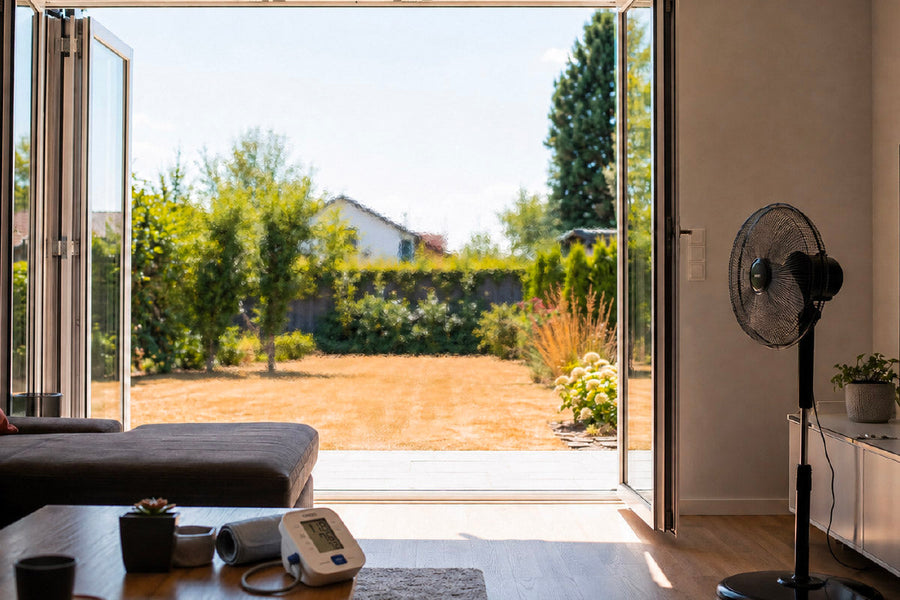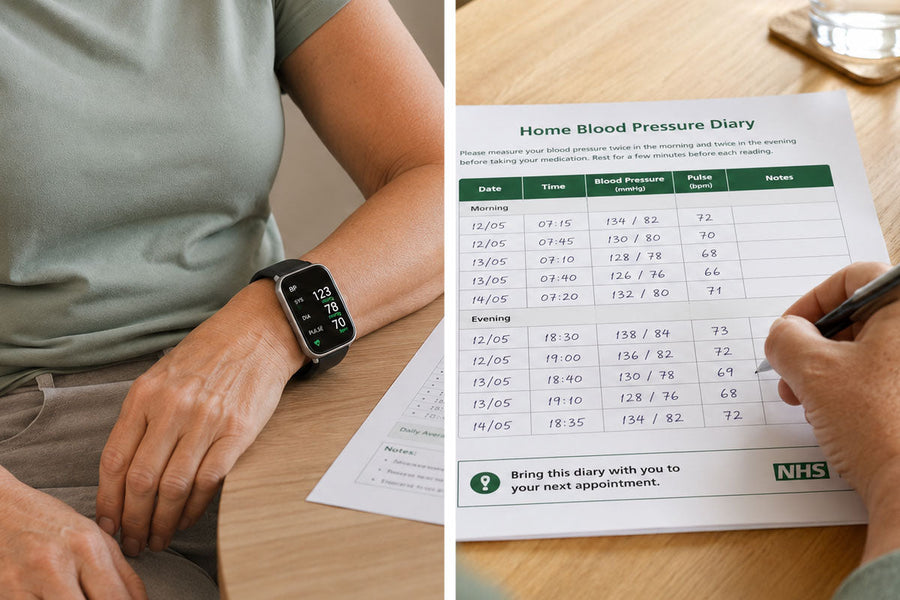
Most people leave a GP surgery with a blood pressure number, a vague sense of concern, and no clear idea what to do next. The NHS now recommends home monitoring as giving a better reflection of your true blood pressure than any single clinic reading. But that only works if you have enough data to tell a spike from a trend. This article works through the GP appointment vs. home blood pressure monitoring question: when does a pattern of home readings warrant a GP call, and how do you arrive at that conversation with data that helps?
Key facts
El artículo en 30 segundos- Over 70% of UK adults had not measured their blood pressure in the past month (Hilo UK BP Report 2025)
- The NHS recommends home monitoring as giving a "better reflection" of true blood pressure than a single clinic reading (NHS England)
- A GP clinic reading has a specificity of just 7% – meaning almost all healthy people are misclassified as potentially hypertensive in a surgery setting (D. Nunan et al., Journal of Hypertension, 2015)
- Blood Pressure UK thresholds: ≥160/100 mmHg → see your GP; ≥180/110 mmHg → within 48 hours (Blood Pressure UK)
Why a single GP reading isn’t the full picture
For most people, a reading taken in a GP surgery comes out higher than their day-to-day blood pressure. The unfamiliar, pressured environment of a clinic shows up in the measurement itself, even though it doesn’t reflect the blood pressure you live with the rest of the time. This is called white coat hypertension, and it is one reason a single clinic number is difficult to interpret.

NICE guidance reflects this directly. Current recommendations advocate suspecting hypertension only if clinic blood pressure is 140/90 mmHg or greater on 2–3 occasions over a period of weeks to months, not on a single reading. Even within that framework, NICE recommends ambulatory blood pressure monitoring (ABPM) or home monitoring to confirm the diagnosis before treatment begins.
The clinical evidence goes further. A diagnostic accuracy study published in the Journal of Hypertension by researchers at the University of Oxford compared GP clinic readings against ambulatory blood pressure monitoring (ABPM) as the reference standard. In the community-based cohort, a GP clinic reading had a high sensitivity (catching most people who genuinely had hypertension) but a specificity of just 7% at a 140/90 mmHg threshold. That means for every 100 people without hypertension, 93 received a reading that could suggest they might have it. Home self-monitoring, the study found, is best used as a test to rule out high blood pressure – and five days of twice-daily readings is sufficient to make an accurate diagnostic decision.
The numbers that matter: UK blood pressure thresholds explained
Most people have seen a threshold number somewhere – 140/90, 160/100, 180/110. These figures matter, but they only mean something in context. A reading of 145/92 on a stressful Monday morning after a poor night’s sleep is not the same as 10 consecutive readings averaging 145/92 over a representative week.
Thresholds assume reliable data. For readings you take yourself at home, the classification below follows the ESH-adapted home blood pressure classification (Hilo threshold guidance, August 2026), with action guidance aligned to Blood Pressure UK and the NHS:
| Home reading (systolic and/or diastolic) | Category | What to do |
|---|---|---|
| < 120 and < 80 mmHg | Optimal | Continue monitoring regularly |
| < 130 and < 85 mmHg | Normal | Continue monitoring regularly |
| 130–134 and < 85 mmHg | High-normal | Worth monitoring regularly |
| 135–159 and/or 85–99 mmHg | High, Grade 1 | Worth discussing with your GP if readings stay in this range |
| 160–179 and/or 100–109 mmHg | High, Grade 2 | See your GP |
| ≥ 180 and/or ≥ 110 mmHg | High, Grade 3 | See your GP within 48 hours |
| ≥ 180/110 mmHg + symptoms* | Emergency | Call 999 immediately |
*Symptoms to watch for: chest pain, severe headache, visual disturbance, sudden shortness of breath.
Classify your systolic and diastolic values independently and go by the higher of the two: a diastolic reading of 85 mmHg or above already falls into High Grade 1, even when your systolic value is still normal.
The NICE-recommended home monitoring protocol – two readings in the morning and two in the evening for five to seven days – is what GPs are taught to request when they suspect hypertension. This protocol exists precisely because a single clinic reading, whether high or normal, doesn’t carry enough diagnostic weight on its own.
What home monitoring actually tells you (and what it doesn’t)
Home monitoring is a clinically reliable way to rule out high blood pressure, and the Oxford study above found five days of twice-daily readings sufficient for an accurate diagnostic decision. But "home monitoring" covers a wide range of behaviours (from someone who measures once a month to someone running the full NICE protocol), and the clinical value depends almost entirely on how much data you have.
According to the Hilo UK BP Report 2025, which surveyed 2,000 UK adults and analysed anonymised data from 8,950 British Hilo users, over 70% of UK adults had not measured their blood pressure in the past month. Only around one in four took their last reading at home; the majority relied on a GP visit. And despite government data suggesting up to a third of UK adults have high blood pressure, only around 25% of those surveyed recalled a hypertension diagnosis: a significant gap between the scale of the problem and awareness of it. High blood pressure is also closely linked to cognitive decline, making early and consistent monitoring all the more important.
Even among those who do measure at home, the more common pattern is occasional measurement and reaction to individual numbers. The problem is that day-to-day variability in blood pressure is normal. Blood pressure normally runs highest first thing in the morning and falls steadily through the day, according to Blood Pressure UK. Stress, caffeine, salt, alcohol and overall diet all shift the number too (NHS). A single home reading, even taken carefully, can’t distinguish a spike from a trend.
What changes when you have continuous data is the ability to see patterns that occasional measurement can’t capture at all:
| Occasional cuff | Continuous monitoring | |
|---|---|---|
| Readings per day | 1–2 (when remembered) | Throughout day and night |
| Morning surge captured | Sometimes | Always |
| Nocturnal dipping | ✗ | ✓† |
| White coat effect visible | ✗ | ✓ (home vs. away comparison) |
| Trend over weeks | Difficult | Built-in |
| GP-shareable report | Manual log | PDF/CSV export |
†Ambulatory (24-hour) monitoring remains the clinically established method for detecting nocturnal dipping patterns; continuous wearable monitoring is a newer, still-emerging approach for this specific measure.
Nocturnal dipping (the normal fall in blood pressure during sleep) is one of the most clinically significant patterns in cardiovascular risk assessment. Non-dippers and reverse-dippers (people whose blood pressure doesn’t fall, or rises, during sleep) are patterns clinicians take seriously: in patients with peripheral vascular disease, a non-dipping pattern independently predicted cardiovascular events and mortality (N. Dahle et al., 2023). This pattern is entirely invisible to any single daytime measurement, including clinic readings and occasional home cuff checks. Ambulatory monitoring is the clinically established method for detecting nocturnal dipping; continuous wearable monitoring extends that visibility but remains a newer, less-established approach for this specific measure.
When home data makes your GP appointment more valuable
Home monitoring and your GP appointment each become more useful the more data you have. A GP reviewing a week of twice-daily home readings is working with a fundamentally different picture than one seeing a single clinic number.
The Hilo Band is a Class IIa medical device (CE-marked, ISO 81060-2 validated) that measures blood pressure continuously, day and night, without having to remember to take a reading. In clinical validation, its readings differed from reference measurements by a mean of 0.45 ± 7.75 mmHg (systolic) and 0.38 ± 6.86 mmHg (diastolic), within the acceptance criteria of the ISO 81060-2 standard (Hilo science page).
What that produces:
- Day and night profiles, including nocturnal dipping status, invisible to any cuff-based measurement
- Morning surge patterns and Time in Target Range, calibrated to your GP’s recommended threshold
- Long-term trend data – the Hilo UK BP Report 2025 (n=8,950 British users) found that users aged 50+ showed stable systolic values over the measurement period, an observational finding from user data rather than a clinical trial result
- PDF/CSV export ready to share at your next GP appointment
Hilo doesn’t decide whether your readings need a GP visit. It gives you and your doctor the data to make that call confidently. UK pricing: £199.98 for the complete system (band, calibration cuff and first year’s subscription). Subscription renews at £119.99/year.
Signs you should see your GP soon
Contact your GP – don’t wait for a scheduled review – if you see any of the following:
- Average home readings consistently ≥135/85 mmHg over five or more days
- Any single reading ≥180/110 mmHg
- Readings ≥160/100 mmHg on multiple occasions within a week
- A clear upward trend over two to three weeks with no lifestyle explanation
- Call 999 if a reading of 180/110 mmHg or higher is accompanied by: severe headache, chest pain, visual disturbance or sudden shortness of breath
Home monitoring and your GP: better together
Most UK adults arrive at GP appointments with a single number taken in a setting that elevates blood pressure, and leave without knowing whether that number reflects their day-to-day reality. The NHS has moved to change this, building a 7-day home monitoring protocol into its hypertension diagnosis pathway for good reason.
The Hilo Band is how you build that record continuously, so that when you do need your GP, you walk in with a week of clinically meaningful data, not a single number from a difficult morning.
One thing to check before use: the Hilo Band isn’t intended for use during pregnancy, and people with certain implants or pre-existing conditions should check the product documentation or speak to their doctor first.
Walk into your GP appointment with the full picture
The Hilo Band measures your blood pressure continuously, day and night, so you arrive with a week of clinically meaningful data instead of a single number from a difficult morning.
Explore the Hilo BandFAQ
Is home blood pressure monitoring as accurate as a GP reading?
Home monitoring is often more representative of your true blood pressure than a single GP reading, because it removes the white coat effect and captures multiple readings across different times of day. NHS England and NICE both recommend home monitoring as part of the hypertension diagnosis pathway. A 2015 Oxford University study found that five days of home readings provides sufficient accuracy to confirm or rule out a hypertension diagnosis.
What blood pressure reading should make me call my GP?
According to Blood Pressure UK guidance, aligned with NHS and NICE recommendations: a reading at or above 160/100 mmHg warrants a GP appointment; a reading at or above 180/110 mmHg means you should see your GP within 48 hours. If a reading of 180/110 mmHg or higher is accompanied by symptoms such as severe headache, chest pain, visual disturbance or sudden shortness of breath, call 999.
How many home readings do I need before seeing my GP?
NICE recommends two readings in the morning and two in the evening for five to seven days, discarding the first day’s readings. This protocol is the clinical standard most GPs are taught to request when they suspect hypertension. Research from the University of Oxford found that five days of home monitoring is sufficient for accurate diagnostic decision-making.
Can I use a wearable to monitor blood pressure continuously?
Yes. Devices such as the Hilo Band (ISO 81060-2 validated, Class IIa medical device, CE-marked) measure blood pressure throughout the day and night without the need to remember to take a reading. Continuous monitoring captures patterns (including nocturnal dipping and morning surge) that occasional cuff readings and clinic measurements cannot detect. The resulting data can be exported as a PDF or CSV report for sharing with a GP.
Disclaimer: The information in this article is intended for educational purposes only and does not replace medical advice. If you suspect hypertension or are worried about your blood pressure, speak to your doctor. They can advise on the best way to effectively manage it.
Sources
- N. Dahle; J. Ärnlöv; J. Leppert et al. (2023). Nondipping blood pressure pattern predicts cardiovascular events and mortality in patients with atherosclerotic peripheral vascular disease. Vascular Medicine, 28, 274–281. https://doi.org/10.1177/1358863X231161655
- D. Nunan; M. Thompson; C. J. Heneghan et al. (2015). Accuracy of self-monitored blood pressure for diagnosing hypertension in primary care. Journal of Hypertension, 33(4), 755–762. https://doi.org/10.1097/HJH.0000000000000489
- Home Blood Pressure Monitoring. NHS England. https://www.england.nhs.uk/ourwork/clinical-policy/cvd/home-blood-pressure-monitoring/ (Accessed October 2026)
- Who should have a blood pressure check and how often. Blood Pressure UK. https://www.bloodpressureuk.org/your-blood-pressure/getting-diagnosed/who-should-have-a-blood-pressure-check/ (Accessed October 2026)
- A-Z of blood pressure. Blood Pressure UK. https://www.bloodpressureuk.org/resources/a-z-of-blood-pressure/ (Accessed October 2026)
- High blood pressure. NHS. https://www.nhs.uk/conditions/high-blood-pressure/ (Accessed October 2026)
- NICE NG136: Hypertension in adults, diagnosis and management. NICE. https://www.nice.org.uk/guidance/ng136 (Accessed October 2026)