

La Hilo Band: el único dispositivo de monitoreo continuado de la presión arterial clínicamente validado
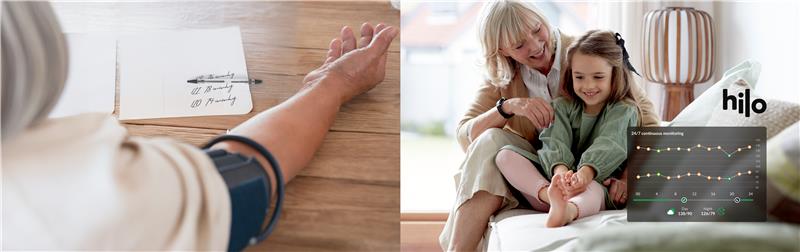
<p class="wp-block-paragraph">Blood pressure (BP) is a strong predictor of cardiovascular health, but only when measured accurately and using standard procedures. <a href="https://www.nhs.uk/conditions/high-blood-pressure/">High blood pressure</a> (hypertension) is a risk factor for heart disease, heart attack, heart failure and stroke, as well as kidney disease and vascular dementia. While hypertension can lead to these severe health issues, it is often symptomless and can be referred to as the ‘silent killer’.</p>
<p class="wp-block-paragraph">Most people only measure their BP when at the doctor’s, or in a medical setting, which means that they only have a snapshot of their BP health. While having some data is better than no data, just because BP measurements are taken in a medical setting doesn’t mean they are a good reflection of a person’s BP patterns and trends. Some patients suffer from <a href="https://www.bloodpressureuk.org/your-blood-pressure/getting-diagnosed/getting-a-blood-pressure-check/">white-coat syndrome</a>, meaning BP is elevated in medical settings, and there can be issues around the <a href="https://www.heart.org/en/news/2022/03/01/when-it-comes-to-accurate-blood-pressure-readings-cuff-size-matters">cuff used fitting the patient correctly</a>, which will also affect measurements. </p>
<p class="wp-block-paragraph">Evidence shows that <a href="https://doi.org/10.1007/s11886-016-0780-3">out-of-office blood pressure measurements</a> – when done consistently over the long-term – can give more reliable data, which enables better prediction of risk for BP-related issues in patients. Usually, when taking BP measurements out-of-office, one of two options are followed:</p>
<ol class="wp-block-list">
<li>
<a href="https://www.england.nhs.uk/ourwork/clinical-policy/cvd/home-blood-pressure-monitoring/">Home Blood Pressure Monitoring (HBPM)</a>: requires patients to repeatedly and manually take their BP using a cuff.</li>
<li>
<a href="https://my.clevelandclinic.org/health/diagnostics/16330-24-hour-ambulatory-blood-pressure-monitoring">Ambulatory Blood Pressure Monitoring (ABPM)</a>: requires patients to continually wear a device that automatically measures BP with a cuff that inflates at regular intervals over 24 hours. </li>
</ol>
<p class="wp-block-paragraph">While both methods can avoid some of the issues seen when taking BP at the doctor’s, both still suffer from drawbacks. For example, both require a cuff, which can be difficult to place correctly, and both rely on technology that can be restrictive for the patient, uncomfortable or inconvenient. In addition, the much more common home BP cuff only gives the user single, isolated, measurements of BP. </p>
<p class="wp-block-paragraph">The <a href="https://hilo.com/uk/blood-pressure-monitor/">Hilo Band</a> is a medically approved device that is able to collect BP data passively, automatically, and is designed for long-term use. </p>
<h2 class="wp-block-heading">How does the Hilo Band work?</h2>
<p class="wp-block-paragraph">The <a href="https://hilo.com/uk/blood-pressure-monitor/">Hilo Band</a> uses optical sensors to automatically measure BP when the in-built accelerometer notes that you have been still for long enough to collect a reliable measurement. Light is shone onto the skin to measure blood volume changes in vessels below the skin’s surface; as blood flows under higher or lower pressure (caused by the heart pumping) the proportion of light absorbed or scattered changes.</p>
<p class="wp-block-paragraph">The first time that you use the device, and then at monthly intervals, it needs to be initialised, where data collected by a Hilo cuff (provided with the subscription) are cross-referenced with data collected by the band. This ensures that the system takes into account your body’s physiology. After initialisation, the device collects dozens of measurements during each 24 hour period, creating a long term overview of your BP’s trends and patterns. The app then converts these measurements into an easy-to-read dataset, allowing you to share this information quickly and easily with medical professionals. </p>
<h2 class="wp-block-heading">How does the accuracy of the Hilo Band compare with a cuff?</h2>
<p class="wp-block-paragraph">While the use of a cuff to measure BP is well-established, it isn’t foolproof. An <a href="https://www.heart.org/en/news/2022/03/01/when-it-comes-to-accurate-blood-pressure-readings-cuff-size-matters">incorrectly sized cuff</a> can lead to incorrect BP readings. For <a href="https://doi.org/10.1001/jamainternmed.2023.3264">patients who are obese</a>, where the cuff is too small, this can lead to overestimation of BP and patients may be prescribed medication when it isn’t necessary. On the other hand, <a href="https://www.heart.org/en/news/2022/03/01/when-it-comes-to-accurate-blood-pressure-readings-cuff-size-matters">underestimation can also be troublesome</a>, leading to missed cases of hypertension, which can have serious consequences. </p>
<p class="wp-block-paragraph">While people can <a href="https://doi.org/10.3399/bjgp20X710381">buy and use cuffs at home</a>, the fact that it is still a cuff means that <a href="https://www.ama-assn.org/delivering-care/hypertension/4-big-ways-bp-measurement-goes-wrong-and-how-tackle-them">user error</a> is still an issue. In addition, home cuffs only provide a single measurement of BP at one point in time – when a person remembers to perform the measurement. Hilo, however, gives a longer-term picture of BP, creating a personal dataset that reveals BP averages and trends. Importantly, when assessing clinical and physiological aspects of health, many sequential data points of BP are required for optimal assessment, and that is exactly what Hilo provides.</p>
<p class="wp-block-paragraph"><em>The Hilo Band, if used correctly, can avoid the issues faced when using an inflatable cuff and provides rapid, regular blood pressure measurements that can be shared easily with medical professionals. </em></p>
<h2 class="wp-block-heading">Hilo: registered as a medical device in the EU</h2>
<p class="wp-block-paragraph">To be registered as a medical device in the EU, as well as for submission to the FDA for approval in the US, the Hilo Band has undergone extensive clinical validation studies. In these tests, the performance of the Hilo Band was assessed against a reference gold-standard, with the full results published in <a href="https://doi.org/10.1038/s41598-021-99294-w">Scientific Reports</a>, a highly-respected peer-reviewed journal. </p>
<p class="wp-block-paragraph">Over these trials the Hilo Band performed extremely well, collecting measurements comparable with those from the reference. In addition, all data collected were rigorously reviewed and cleared by regulatory agencies. </p>
<h2 class="wp-block-heading">The Hilo Band: a convenient device for measuring blood pressure you can trust</h2>
<p class="wp-block-paragraph">Through extensive medical testing and rigorous data analysis, the Hilo Band is proven to be a reliable means for measuring blood pressure continually and non-invasively. </p>
<p class="wp-block-paragraph">Join the Hilo movement and get accurate, clinically-validated readings today</p>
<p class="wp-block-paragraph"><em>This article is for educational purposes only and does not contain, nor replace, medical advice. Consult your physician before making any changes to your diet or lifestyle.</em></p>
<hr class="wp-block-separator has-alpha-channel-opacity">
<h3 class="wp-block-heading">Sources</h3>
<p class="wp-block-paragraph">High Blood Pressure. National Health Service, UK. <a href="https://www.nhs.uk/conditions/high-blood-pressure/">https://www.nhs.uk/conditions/high-blood-pressure</a> (Accessed March 2025)</p>
<p class="wp-block-paragraph">Getting a blood pressure check. Blood Pressure UK. <a href="https://www.bloodpressureuk.org/your-blood-pressure/getting-diagnosed/getting-a-blood-pressure-check/">https://www.bloodpressureuk.org/your-blood-pressure/getting-diagnosed/getting-a-blood-pressure-check</a> (Accessed March 2025)</p>
<p class="wp-block-paragraph">When it comes to accurate blood pressure readings, cuff size matters. American Heart Association. <a href="https://www.heart.org/en/news/2022/03/01/when-it-comes-to-accurate-blood-pressure-readings-cuff-size-matters">https://www.heart.org/en/news/2022/03/01/when-it-comes-to-accurate-blood-pressure-readings-cuff-size-matters</a> (Accessed March 2025)</p>
<p class="wp-block-paragraph">J. B. Cohen, D. L. Cohen (2016). Integrating Out-of-Office Blood Pressure in the Diagnosis and Management of Hypertension. Curr. Cardiol. Rep., 18, 112. <a href="https://doi.org/10.1007/s11886-016-0780-3">https://doi.org/10.1007/s11886-016-0780-3</a></p>
<p class="wp-block-paragraph">Home blood pressure monitoring. National Health Service, UK. <a href="https://www.england.nhs.uk/ourwork/clinical-policy/cvd/home-blood-pressure-monitoring/">https://www.england.nhs.uk/ourwork/clinical-policy/cvd/home-blood-pressure-monitoring</a> (Accessed March 2025)</p>
<p class="wp-block-paragraph">24-Hour Ambulatory Blood Pressure Monitoring. Cleveland Clinic. <a href="https://my.clevelandclinic.org/health/diagnostics/16330-24-hour-ambulatory-blood-pressure-monitoring">https://my.clevelandclinic.org/health/diagnostics/16330-24-hour-ambulatory-blood-pressure-monitoring</a> (Accessed March 2025)</p>
<p class="wp-block-paragraph">J. Ishigami, J. Charleston, E. R. Miller III <em>et al</em>. (2023). Effects of Cuff Size on the Accuracy of Blood Pressure Readings: The Cuff(SZ) Randomized Crossover Trial. <em>JAMA Intern. Med.</em>, 183 (10), 1061. <a href="https://doi.org/10.1001/jamainternmed.2023.3264">https://doi.org/10.1001/jamainternmed.2023.3264</a></p>
<p class="wp-block-paragraph">J. A. Hodgkinson, M.-M. Lee, S. Milner <em>et al.</em> (2020). Accuracy of blood-pressure monitors owned by patients with hypertension (ACCU-RATE study): a cross-sectional, observational study in central England, <em>BJGP</em>, 70 (697), e548. <a href="https://doi.org/10.3399/bjgp20X710381">https://doi.org/10.3399/bjgp20X710381</a></p>
<p class="wp-block-paragraph">4 big ways BP measurement goes wrong, and how to tackle them. American Medical Association. <a href="https://www.ama-assn.org/delivering-care/hypertension/4-big-ways-bp-measurement-goes-wrong-and-how-tackle-them">https://www.ama-assn.org/delivering-care/hypertension/4-big-ways-bp-measurement-goes-wrong-and-how-tackle-them</a> (Accessed March 2025)</p>
<p class="wp-block-paragraph">J. Sola, A. Vybornova, S. Fallet <em>et al.</em> (2021). Validation of the optical Hilo bracelet in different body positions for the persistent monitoring of blood pressure. Sci. Rep., 11, 20644. <a href="https://doi.org/10.1038/s41598-021-99294-w">https://doi.org/10.1038/s41598-021-99294-w</a></p>
Leer más

La hipertensión arterial a edades tempranas puede aumentar el riesgo de desarrollar problemas de salud graves, como accidente cerebrovascular e infarto de miocardio, en etapas posteriores de la vida.

Para mantener la presión arterial dentro de un rango saludable puede ser útil consumir alimentos ricos en nutrientes y controlar de forma continuada la presión arterial.

El alcohol tiene un efecto directo sobre la presión arterial. Descubra cómo controlar su consumo de alcohol para cuidar su salud cardíaca.

Sobre el revisor médico
Dr Jay Shah
MD, FACC · Asesor médico y revisor