

How to choose a blood pressure monitor: the UK buying guide
You have probably had your blood pressure (BP) taken at the doctor’s more times than you can count – but those spot checks capture just a moment, not the pattern behind your numbers. A home monitor lets you measure whenever you need to, away from the white coat effect that can push readings up in a clinical setting. This guide explains what a blood pressure monitor is, which devices the NHS and NICE point you towards, and how to choose between an upper-arm cuff, a wrist cuff and a cuffless band.
Which blood pressure monitor
is really right for you?
Answer 6 short questions and get your personalised top 3 recommendation.
Key facts at a glance
- Check validation first. NHS England and NICE recommend choosing a device from the British and Irish Hypertension Society (BIHS) validated list.
- Upper-arm cuffs are the reference standard for home measurement; wrist cuffs are known to be less accurate.
- Cuffless bands estimate BP optically. The Hilo Band is a CE-certified medical device, whereas the Apple Watch only flags possible signs of hypertension and the WHOOP BP feature is not FDA-cleared.
- Fit matters as much as features. Ease of use, display size and cuff handling decide whether a monitor actually gets used.
What is a blood pressure monitor?
A blood pressure monitor – technically a sphygmomanometer – measures the pressure in your arteries as your heart pumps (systolic) and rests between beats (diastolic).
The main types:
- Upper-arm cuff: the cuff wraps around your brachial artery. It inflates automatically in digital devices and measures via oscillometric detection. This is the type most medical professionals use.
- Wrist cuff: worn on the radial artery at the wrist. An option when an arm cuff cannot be used, but known to be less accurate than upper-arm versions.
- Cuffless wearables: wrist- or finger-worn devices that use optical signals to estimate BP. Some take spot checks, others measure repeatedly through the day and night to show your BP pattern.
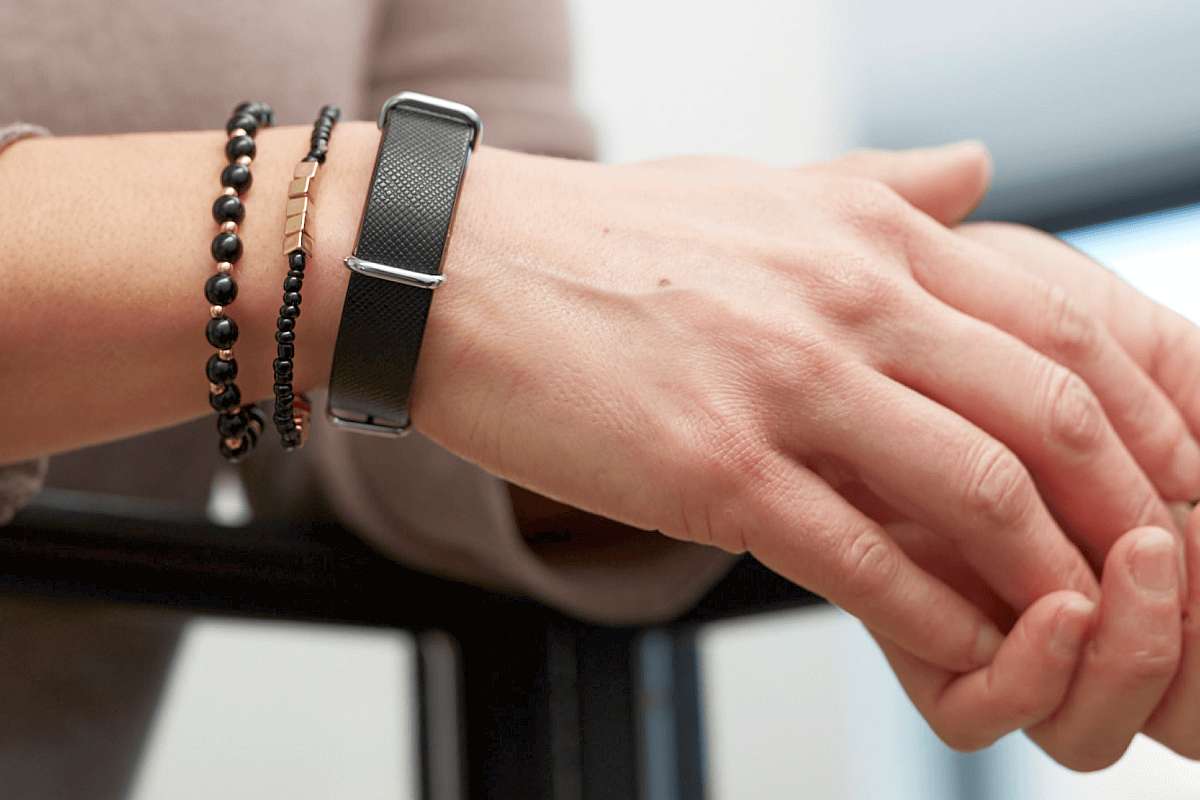
The Hilo Band is a cuffless, wrist-worn medical device that measures your BP automatically – including while you sleep – calibrated with the accompanying upper-arm cuff, and shows you the pattern behind your numbers. The underlying technology has FDA and EU approval, built on 14 clinical studies, including 4 validation trials, and more than 20 years of research.
Why monitor your blood pressure at home?
Home blood pressure monitoring gives you and your doctor more data than an occasional clinic reading ever can. There is evidence that home monitoring can help improve BP control, as a review in the European Cardiology Review concluded, and it aids the diagnosis of conditions such as white-coat hypertension and masked hypertension.
It is especially helpful for:
- People with hypertension
- People with a family history of hypertension
- People with medical conditions that raise hypertension risk
- People who cannot visit their doctor regularly
NHS and BIHS validation: which monitors can you trust?
Accuracy is one of the most important buying criteria. In the UK, the reference point is the BIHS validated monitor list – the list NHS England and NICE point buyers towards when they recommend home monitoring.
| The list tells you | The list does not tell you |
|---|---|
| Devices that have met internationally recognised validation protocols | Price, availability or ease of use |
| Monitors suitable for both clinical and home settings | A "best buy" ranking |
| Which devices could not be approved due to protocol violations | Anything about devices not (yet) validated under those protocols |
Where cuffless systems sit. For a cuffless option, look for medical-device certification: CE marking as a medical device, and clinical validation published in peer-reviewed studies. The Hilo Band holds CE marking as a medical device, and its measurement accuracy has been validated in peer-reviewed clinical trials. That distinction matters: it separates certified medical devices from consumer wearables whose BP features are wellness tools without medical clearance.
What to consider when buying a blood pressure monitor
Before you buy, check whether the device is on the BIHS validated list or certified as a medical device with published clinical studies, since validation is what makes a reading trustworthy. Then think about the cuff type: upper-arm cuffs are the accuracy reference, and a wrist cuff is only worth considering if an arm cuff is not an option for you. Ease of use matters just as much – ask whether you can position the cuff, start a reading and read the display without difficulty. Also look at what the device does with your data: does it show trends over time, or only single readings, and can you export or share the results with your doctor? And finally, be honest about comfort, because a monitor you find unpleasant to wear or use will not get used as often as you need it to.
How do smartwatches compare?
Devices such as the Apple Watch and WHOOP offer BP-related features, but with important limits:
- The WHOOP BP feature is not FDA-cleared and is described by the maker as a wellness feature; it needs calibration against a separate cuff and gives a once-daily estimate.
- The Apple Watch has been approved for hypertension detection, but it does not give mmHg readings – it flags possible signs, which are a reason to follow up with your doctor.
The Hilo Band, by contrast, is a cuffless medical device that gives regular mmHg measurements. Its optical sensors, calibrated via the upper-arm cuff, measure blood volume changes under the skin whenever its accelerometer notes you have been still long enough for reliable data. Read our Evidence page for more on Hilo’s validated accuracy.
Upper-arm cuff vs wrist cuff vs cuffless band
Each device type takes a different trade-off between accuracy, effort and the picture it gives you. The table below compares the three options on the criteria that matter most when choosing – including the two questions buyers ask most often: which device is easy to use but still medically reliable, and which one can you trust for overnight readings.
| Criterion | Upper-arm cuff | Wrist cuff | Cuffless band (Hilo) |
|---|---|---|---|
| Measurement principle | Inflatable cuff, oscillometric | Inflatable cuff at wrist | Optical sensors, calibrated via cuff |
| Accuracy standing | Reference standard | Less accurate than upper-arm | Validated in peer-reviewed clinical trials |
| Effort per reading | Manual positioning and inflation | Manual positioning, sensitive to wrist height | Automatic, no action needed |
| Overnight readings | No | No | Yes, including during sleep |
| Pattern over time | Only if you log readings manually | Only if you log readings manually | Shown automatically in the app |
| Doctor sharing | Depends on model | Depends on model | Can be shared with your doctor |
If you want the simplest medically reliable route: a validated upper-arm cuff, used correctly. If you want to see your BP pattern – including overnight – a validated cuffless band is the option designed for exactly that.
Choosing a monitor if you’re over 65
High blood pressure becomes more common with age (S. S. Franklin; W. Gustin; N. D. Wong et al., 1997), and a monitor that is technically accurate but hard to use will not get used. Look for:
- Simple cuff handling: upper-arm cuffs need correct positioning; a cuffless band avoids this step entirely.
- Legible display: large digits and clear labels matter more than extra features.
- No forgotten measurements: devices that measure automatically remove the reliance on remembering to take a reading.
- Carer sharing: the option to share results with a family member or carer, so someone else can keep an eye on the numbers too.
The Hilo Band measures automatically through the day and night, so readings happen even when measuring is the last thing on your mind – and the results can be shared with your doctor.
Which blood pressure monitor should you buy?
The best monitor is the one that fits your needs and lifestyle:
- Accurate and validated
- Comfortable to wear and use
- Cost-effective
- Easy to use
- Helpful for managing your health
At Hilo, we believe the Hilo Band fits these criteria: it costs £199.98 (£79.99 band + £119.99 annual subscription) and measures your BP automatically day and night, so you and your physician can understand your blood pressure pattern together and see how lifestyle changes or treatments affect it. Your doctor can keep an eye on your numbers if needed.
The bottom line
Choose a validated device – a BIHS-listed cuff or a certified cuffless medical device – that you will actually use often enough to see your pattern. If you are unsure where to start, use the comparison above: a validated upper-arm cuff for the simplest reliable readings, or a validated cuffless band if you want to see your BP pattern over time, including overnight.
Whatever device you choose, our research has shown that raising awareness of blood pressure increases motivation to keep an eye on your numbers – and individuals who monitored their blood pressure continuously showed better blood pressure control over time and halted the age-related rise in systolic blood pressure typically seen in the general population.
Ready to see your blood pressure pattern?
The Hilo Band measures your blood pressure automatically throughout the day and night, so you and your doctor can see the pattern behind single readings.
Discover the Hilo BandOne thing to check before use: the Hilo Band isn’t intended for use during pregnancy, and people with certain implants or pre-existing conditions should check the product documentation or speak to their doctor first.
Disclaimer: The information in this article is intended for educational purposes only and does not replace medical advice. If you suspect hypertension or are worried about your blood pressure, speak to your doctor. They can advise on the best way to effectively manage it. All data correct at the time of writing.
Sources
- J. George; T. M. MacDonald (2015). Home Blood Pressure Monitoring. Eur. Cardiol. Rev., 10(2), 95. https://doi.org/10.15420/ecr.2015.10.2.95
- S. S. Franklin; W. Gustin; N. D. Wong et al. (1997). Hemodynamic patterns of age-related changes in blood pressure: the Framingham Heart Study. Circulation, 96(1), 308–315. https://www.ahajournals.org/doi/10.1161/01.cir.96.1.308
- J. Sola; A. Vybornova; S. Fallet et al. (2021). Validation of the optical Aktiia bracelet in different body positions for the persistent monitoring of blood pressure. Sci. Rep., 11, 20644. https://www.nature.com/articles/s41598-021-99294-w
- Validated BP Monitors: Clinical, Policy, and Procurement Guidance. British and Irish Hypertension Society (BIHS). https://bihs.org.uk/blood_pressure_technology/bp_monitor_validations.aspx (Accessed October 2026)
- US FDA clears Apple Watch hypertension feature. Reuters. https://www.reuters.com/sustainability/boards-policy-regulation/us-fda-clears-apple-watch-hypertension-feature-2025-09-12 (Accessed March 2026)
- U.S. Food and Drug Administration (2025). Warning Letter: WHOOP, Inc. https://www.fda.gov/inspections-compliance-enforcement-and-criminal-investigations/warning-letters/whoop-inc-709755-07142025 (Accessed October 2026)
- Getting a Blood Pressure Check. Blood Pressure UK. https://www.bloodpressureuk.org/your-blood-pressure/getting-diagnosed/getting-a-blood-pressure-check (Accessed January 2026)
- Blood Pressure Measurement Devices. Medicines & Healthcare Products Regulatory Agency. https://assets.publishing.service.gov.uk/media/60117932e90e0714325ec41d/Blood_pressure_measurement_devices.pdf (Accessed January 2026)
- How to choose a blood pressure monitor. British Heart Foundation. https://www.bhf.org.uk/informationsupport/heart-matters-magazine/medical/tests/blood-pressure-measuring-at-home#takingareading (Accessed January 2026)
Read more

Keep your mind sharp post-50. Discover the critical role your blood pressure plays in memory and thinking. Read now!

Discover how families can work together to prevent high blood pressure. Learn practical strategies for heart health across generations and the benefits of open communication about health.
Discover why your blood pressure might spike at night and how it can impact your diabetes. Learn now!