

How to lower diastolic blood pressure: a UK guide

You’ve just had a blood pressure reading and the top number looks fine. The bottom number, though, has been flagged, and no one really explained what that means for you. If that sounds familiar, your diastolic blood pressure deserves a closer look: it can move on its own, separate from the systolic number (S. S. Franklin; W. Gustin; N. D. Wong et al., 1997), and that pattern is common and well understood. This guide explains what your diastolic number actually tells you, how it changes with age, how low it should go, and the everyday habits that support a healthier bottom number.
Which blood pressure monitor
is really right for you?
Answer 6 short questions and get your personalised top 3 recommendation.
Key takeaways
- The bottom number matters on its own: A normal systolic reading doesn’t make an elevated diastolic number irrelevant; UK thresholds apply to the reading as a whole (NHS).
- Its own age curve: Diastolic pressure tends to rise until around age 50 to 60, then eases, while the systolic number keeps climbing (S. S. Franklin; W. Gustin; N. D. Wong et al., 1997).
- The same habits help both numbers: Weight, salt, aerobic exercise and sleep support the diastolic number over weeks to months (D. W. Jones; K. C. Ferdinand; S. J. Taler et al., 2025; M. P. St-Onge et al., 2025); untreated sleep apnoea is a commonly missed driver (M. F. Pengo; E. I. Schwarz; F. Barbé et al., 2025).
- Your pattern over time: Hilo can help you see how your diastolic number trends over weeks and bring that context to your doctor.
What your diastolic number is actually telling you
Every blood pressure reading gives you two numbers, and each describes a different moment of the same process. The systolic pressure is the highest level your blood pressure reaches when your heart pumps blood around the body. The diastolic pressure is the lowest level it reaches when your heart relaxes between beats (NHS).
It’s a common assumption that a normal top number makes the bottom number unimportant. In the UK, though, a reading is usually considered high at 140/90 mmHg or higher when measured by a healthcare professional, or 135/85 mmHg or higher when you check it at home (NHS). A healthy systolic value on its own therefore doesn’t rule out a raised diastolic one.
Some people see a consistent pattern where the bottom number runs high while the top number stays normal. Doctors call this isolated diastolic hypertension, and it’s a recognised pattern. Health systems also set their blood pressure numbers differently, which is worth knowing before you compare notes with US-based information online.
In the US, the ACC/AHA guideline recommends a treatment target below 130/80 mmHg for adults (P. L. Vemu; E. Yang; J. Ebinger, 2024), while UK guidance sets blood pressure targets that differ by age band (NICE NG136). For a UK reader, the NHS and NICE numbers are the ones to discuss with your doctor.
Why the diastolic number behaves differently as you get older
The two numbers also age differently. Findings from the Framingham Heart Study show that systolic blood pressure tends to increase with age, while diastolic blood pressure typically rises until around age 50 to 60 before declining, a pattern thought to reflect increasing arterial stiffness (S. S. Franklin; W. Gustin; N. D. Wong et al., 1997).
Until around age 50 to 60, the diastolic curve is still climbing (S. S. Franklin; W. Gustin; N. D. Wong et al., 1997), which is why an elevated bottom number alongside a normal top number shows up more often in younger and middle-aged adults. If you’re under 55 and seeing this pattern, you’re looking at a recognised stage of the age curve.
Age also changes what any single reading means. The same diastolic value can sit at a different point of the curve depending on whether you’re 45 or 75, which is one reason a one-off measurement is best read in context.
How low should the diastolic number go?
Once you start working on the bottom number, the mirror-image question appears: how low is too low? European guidance cautions that blood pressure under treatment should not be targeted below 120/70 mmHg, because of a higher risk of adverse reactions and treatment discontinuation (P. Verdecchia; E. Grossmann; P. Whelton, 2023). That caution is specific to treated patients, and the target itself is set with your doctor.
In the UK, treatment targets are set out in NICE guidance (NG136), and they differ by age band:
- Under 80: adults with hypertension have a clinic blood pressure target below 140/90 mmHg, with a corresponding target below 135/85 mmHg on ambulatory blood pressure monitoring (ABPM) or home blood pressure monitoring (HBPM).
- 80 and over: a clinic target below 150/90 mmHg, with a corresponding ABPM/HBPM target below 145/85 mmHg.

Diagnosis uses the same thresholds: a clinic reading of 140/90 mmHg or higher, confirmed by a daytime average of 135/85 mmHg or higher on ambulatory or home monitoring (NICE NG136).
A large genetic study of more than 47,000 adults found no sign that naturally low diastolic blood pressure throughout life raises the risk of heart attack, even at around 50 mmHg (M. Arvanitis; G. Qi; D. L. Bhatt et al., 2021). This doesn’t apply to blood pressure lowered with medication, and it doesn’t mean 50 mmHg is a safe target for everyone.
The practical conclusion: there’s no single universal 'too low' number. For anyone on treatment, the right target is a decision made with their doctor, informed by their overall health and their readings over time.
Everyday habits that support a healthier diastolic number
The everyday habits that help the top number also support the bottom one. The evidence below mixes both measurements, so each figure is labelled with what it was actually measured on: some effects were demonstrated on systolic pressure, and where a diastolic figure exists, it’s stated alongside.
- Weight: weight loss is associated with a blood pressure reduction of roughly 1 mmHg for every kilogram lost (B. Han; G. B. Lee; J. Yoon et al., 2025, summarising the 2025 AHA/ACC guideline).
- Aerobic exercise: regular aerobic activity can lower systolic blood pressure by about 4 to 8 mmHg in adults with hypertension (D. W. Jones; K. C. Ferdinand; S. J. Taler et al., 2025). For the diastolic number specifically, a meta-analysis of randomised controlled trials found aerobic training reduced diastolic blood pressure by 5.19 mmHg (95% confidence interval −6.24 to −4.14) (B. Jabbarzadeh Ganjeh; S. Zeraattalab-Motlagh; A. Jayedi et al., 2024).
- Salt: reducing sodium intake to below 2,300 mg a day, ideally towards 1,500 mg, can lower systolic blood pressure by about 6 to 8 mmHg on average in adults with hypertension (D. W. Jones; K. C. Ferdinand; S. J. Taler et al., 2025). For the diastolic number, a Cochrane review of 34 studies found that a 4.4 g/day reduction in salt intake lowered diastolic blood pressure by 2.06 mmHg (F. J. He; J. Li; G. A. MacGregor, 2013).
Two things are worth knowing about how these effects show up. First, they build over weeks to months, so an unchanged reading after a fortnight of change is normal. Second, the effects often become visible only once several habits change together.
Sleep apnoea: an overlooked driver of a stubborn diastolic number
Sleep belongs on the list too. Most adults should aim for 7 to 9 hours of sleep each night, and regularly getting insufficient sleep is associated with a higher risk of high blood pressure and abnormal night-time blood pressure patterns (M. P. St-Onge et al., 2025). One sleep-related condition deserves particular attention when the bottom number refuses to budge.
Obstructive sleep apnoea causes repeated breathing interruptions during sleep, and each interruption triggers a surge in blood pressure. Over time, that can contribute to elevated blood pressure at night and during the day (M. F. Pengo; E. I. Schwarz; F. Barbé et al., 2025). CPAP therapy, which keeps the airway open, typically lowers blood pressure modestly, with its largest effect at night; it can improve nocturnal blood pressure patterns but doesn’t reliably restore normal dipping (the natural fall in blood pressure during sleep) in every patient (L. Benning; J. J. Herzig; M. S. Mollet et al., 2025).
If you snore, choke or gasp during sleep, or feel sleepy during the day, ask your doctor whether an assessment for sleep apnoea is appropriate (D. W. Jones; K. C. Ferdinand; S. J. Taler et al., 2025).
When lifestyle changes aren’t enough on their own
Sometimes the number stays high even when the habits are in place. Genuinely elevated blood pressure often needs medication, and that’s a decision for your doctor. Lifestyle changes work alongside medication rather than instead of it, and long-term, consistent lifestyle change may reduce how much medication someone needs, but only a doctor decides if and when that’s possible.
If you’re already taking blood pressure medication, never stop or adjust it without speaking to your doctor first. The target you’re aiming for and the plan to get there are set together at your appointments, and the pattern of your readings over time is something you and your doctor can review at each one.
Seeing your pattern, not just one reading
Hilo can help you see how your diastolic number trends over time and bring that context to your doctor. A single reading, at home or at the doctor’s, captures your blood pressure in one moment: it shows you a value, but not the pattern behind it. Because the diastolic number follows its own age curve and responds to lifestyle change over weeks, a view across many weeks adds what a single number lacks.
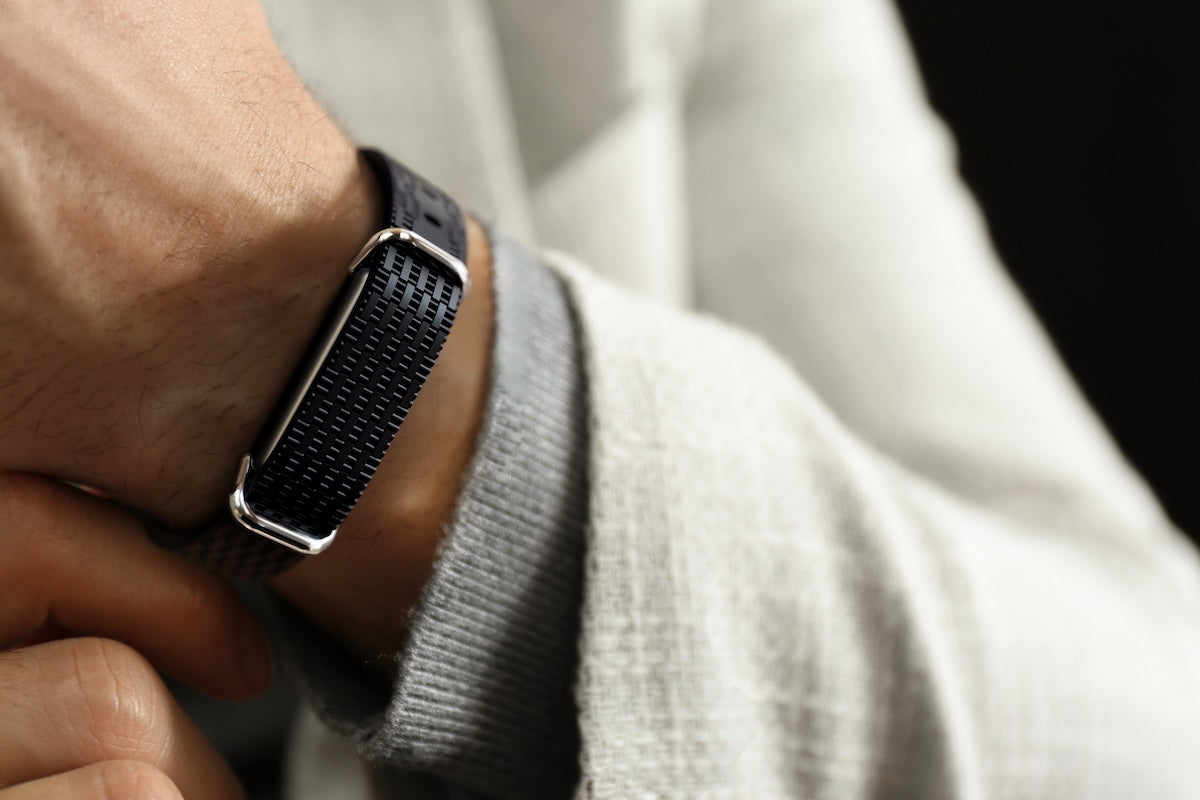
The band captures reference measurements through the day to reveal how your blood pressure moves over time, and the validated cuff provides the reference measurements that keep the system calibrated. The result is everyday context you and your doctor can review together, alongside whatever monitoring your doctor arranges.
The bottom number deserves its own attention
The diastolic number follows its own curve across your life, typically rising until around age 50 to 60 before easing while the systolic number keeps climbing (S. S. Franklin; W. Gustin; N. D. Wong et al., 1997). It responds to the same everyday levers as the top number, just more slowly and less visibly (D. W. Jones; K. C. Ferdinand; S. J. Taler et al., 2025), and untreated sleep apnoea is a commonly missed driver worth screening for (M. F. Pengo; E. I. Schwarz; F. Barbé et al., 2025). There’s no single 'too low' number without your doctor’s input. Understanding the pattern, rather than reacting to any one reading, is what puts you in the best position to look after your blood pressure for the long term.
See the pattern behind your readings
The Hilo Band captures reference measurements through the day, and the validated cuff keeps the system calibrated, so you can see how your blood pressure moves over weeks and bring that context to your doctor.
Find out more about the Hilo BandFAQ
Can your diastolic (bottom) number be high even if your top number is normal?
Yes. The bottom number can be elevated while the systolic number stays in the normal range, a pattern doctors call isolated diastolic hypertension. In the UK, the general NHS thresholds apply, with a reading usually considered high at 140/90 mmHg or higher at a clinic or 135/85 mmHg or higher at home (NHS). If you see this shape in your readings, it’s worth discussing with your doctor, even when the top number looks fine.
Does diastolic blood pressure change as you get older?
Yes. Diastolic pressure typically rises until around age 50 to 60 and then declines, while systolic pressure keeps increasing with age (S. S. Franklin; W. Gustin; N. D. Wong et al., 1997). That’s why an elevated bottom number with a normal top number shows up more often in younger and middle-aged adults, and why the same reading can mean something different at 45 than at 75.
Can sleep apnoea raise diastolic blood pressure specifically?
It can contribute to it. Obstructive sleep apnoea causes repeated breathing interruptions during sleep, each triggering a blood pressure surge, which can contribute to elevated pressure at night and during the day (M. F. Pengo; E. I. Schwarz; F. Barbé et al., 2025). CPAP therapy typically lowers blood pressure modestly, with the largest effect at night (L. Benning; J. J. Herzig; M. S. Mollet et al., 2025). If you snore, choke or gasp during sleep, or feel sleepy during the day, ask your doctor whether an assessment for sleep apnoea is appropriate (D. W. Jones; K. C. Ferdinand; S. J. Taler et al., 2025).
Is a diastolic reading in the 80s something to worry about?
Context matters more than the single value. UK thresholds consider a reading high at 140/90 mmHg or higher at a clinic, or 135/85 mmHg or higher at home, so where a diastolic value in the 80s sits depends on how and where it was measured (NHS). Track the pattern over a few weeks and discuss it with your doctor, who can weigh it alongside your overall health and risk factors.
Join the Hilo newsletter for medical insights, early feature releases, and expert guidance on heart health.
Disclaimer: The information in this article is intended for educational purposes only and does not replace medical advice. If you suspect hypertension or are worried about your blood pressure, speak to your doctor. They can advise on the best way to effectively manage it.
Sources
- D. W. Jones; K. C. Ferdinand; S. J. Taler et al. (2025). 2025 AHA/ACC/AANP/AAPA/ABC/ACCP/ACPM/AGS/AMA/ASPC/NMA/PCNA/SGIM Guideline for the Prevention, Detection, Evaluation, and Management of High Blood Pressure in Adults. Circulation, 152, e114–e218.
https://doi.org/10.1161/CIR.0000000000001356 - B. Han; G. B. Lee; J. Yoon et al. (2025). Lifestyle interventions for hypertension management in primary care: a narrative review. Ewha Medical Journal, 48(4), e56.
https://pmc.ncbi.nlm.nih.gov/articles/PMC12611427/ - M. P. St-Onge et al. (2025). Multidimensional Sleep Health: Definitions and Implications for Cardiometabolic Health: A Scientific Statement From the American Heart Association. Circ Cardiovasc Qual Outcomes, 18(5), e000139.
https://doi.org/10.1161/HCQ.0000000000000139 - M. F. Pengo; E. I. Schwarz; F. Barbé et al. (2025). Effect of CPAP therapy on blood pressure in patients with obstructive sleep apnoea: a worldwide individual patient data meta-analysis. European Respiratory Journal, 65(1), 2400837.
https://doi.org/10.1183/13993003.00837-2024 - L. Benning; J. J. Herzig; M. S. Mollet et al. (2025). Effects of CPAP on Blood Pressure Parameter Across Different Severities of Obstructive Sleep Apnoea: A Meta-Analysis. Journal of Sleep Research, 34(5), e70072.
https://doi.org/10.1111/jsr.70072 - B. Jabbarzadeh Ganjeh; S. Zeraattalab-Motlagh; A. Jayedi et al. (2024). Effects of aerobic exercise on blood pressure in patients with hypertension: a systematic review and dose-response meta-analysis of randomized trials. Hypertension Research, 47(2), 385–398.
https://www.nature.com/articles/s41440-023-01467-9 - P. Verdecchia; E. Grossmann; P. Whelton (2023). 2023 ESH Guidelines. What are the main recommendations? European Journal of Internal Medicine, 116, 1–7.
https://www.ejinme.com/article/S0953-6205(23)00265-0/fulltext - M. Arvanitis; G. Qi; D. L. Bhatt et al. (2021). Linear and Nonlinear Mendelian Randomization Analyses of the Association Between Diastolic Blood Pressure and Cardiovascular Events: The J-Curve Revisited. Circulation, 143(9), 895–906.
https://doi.org/10.1161/CIRCULATIONAHA.120.049819 - F. J. He; J. Li; G. A. MacGregor (2013). Effect of longer term modest salt reduction on blood pressure: Cochrane systematic review and meta-analysis of randomised trials. BMJ, 346, f1325.
https://www.cochranelibrary.com/cdsr/doi/10.1002/14651858.CD004937.pub2/abstract - S. S. Franklin; W. Gustin; N. D. Wong et al. (1997). Hemodynamic patterns of age-related changes in blood pressure: the Framingham Heart Study. Circulation, 96(1), 308–315.
https://www.ahajournals.org/doi/10.1161/01.cir.96.1.308 - Blood pressure test. NHS.
https://www.nhs.uk/tests-and-treatments/blood-pressure-test/
(Accessed October 2026) - Hypertension in adults: diagnosis and management (NG136). NICE.
https://www.nice.org.uk/guidance/ng136/chapter/recommendations
(Accessed October 2026) - P. L. Vemu; E. Yang; J. Ebinger. 2023 ESH Hypertension Guideline Update: Bringing Us Closer Together Across the Pond. American College of Cardiology.
https://www.acc.org/Latest-in-Cardiology/Articles/2024/02/05/11/43/2023-ESH-Hypertension-Guideline-Update
(Accessed October 2026)
Read more
Some medical conditions can affect your BP data if it’s being taken at the doctors. This article will look at some of those conditions, and consider ways of managing them.

Garlic has long been touted a treatment for lowering blood pressure in hypertensive individuals, but is there any truth in this claim? This short article will examine the evidence, and provide an a...

Learn how walking can help lower blood pressure, reduce hypertension risk, and support heart health. See how many steps to aim for and how Hilo can help.