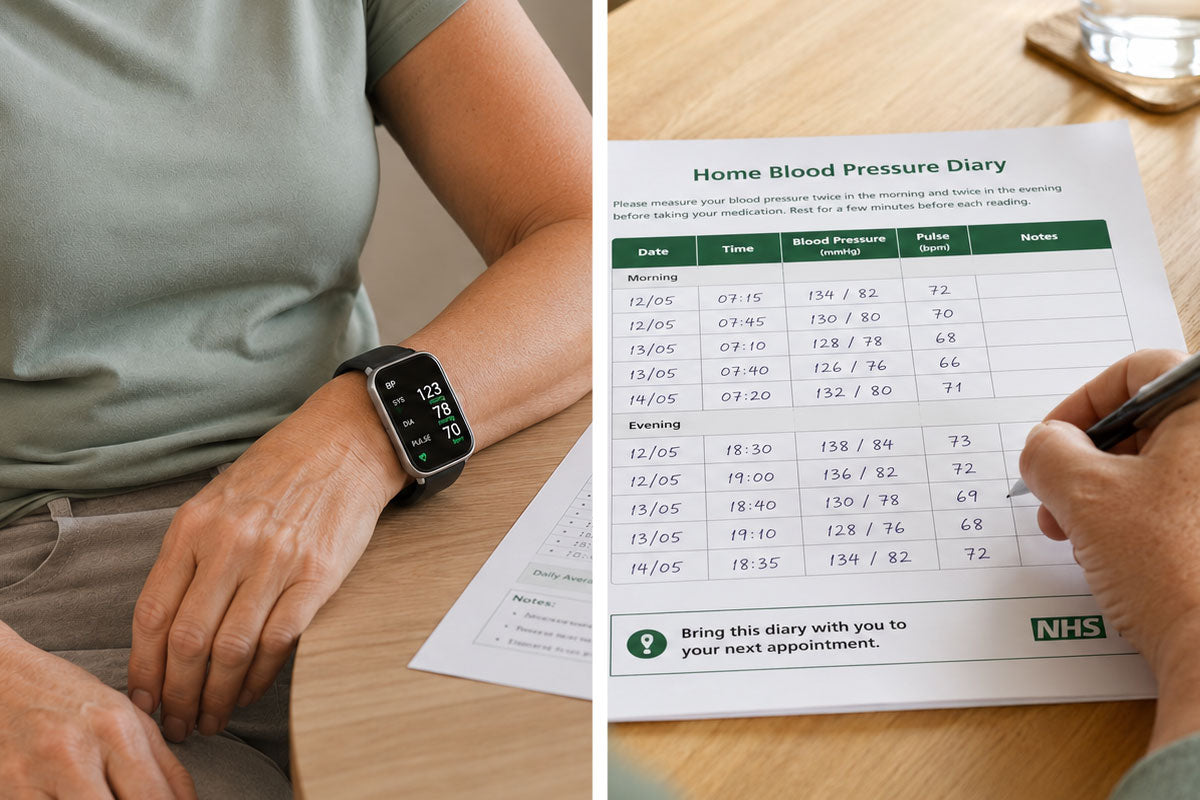
You set the alarm, skip your morning coffee, sit quietly for five minutes, and take two readings a minute apart. Then you do it all again in the evening, for seven days straight, before handing the NHS home blood pressure diary back to your GP. It feels thorough. But four waking readings a day cannot show what your blood pressure does during sleep, during a stressful meeting, or in the hour after you wake. This article compares the NHS diary protocol, 24-hour ABPM, and continuous wearable monitoring with Hilo, so you can see where each one helps and where each one stops short.
Key Facts
Der Artikel in 30 Sekunden- Reading volume: A 7-day NHS diary produces around 28 daytime readings, while continuous monitoring captures an average of 31 readings per day, including overnight.
- Lower home threshold: According to NICE NG136, the home diagnostic threshold is 135/85mmHg versus 140/90mmHg in clinic, so values that look mild at the surgery may already signal hypertension at home.
- Nocturnal blind spot: The diary records zero nighttime data, yet nocturnal blood pressure is reported as a strong risk factor for cardiovascular events.
- UK monitoring gap: According to the Hilo Blood Pressure Report 2025, more than 70% of UK adults had not checked their blood pressure in the previous month, and almost one in five had not done so in over two years, or could not recall when they last measured it.
Why the NHS Diary Alone Can Miss Real Hypertension
The NHS home blood pressure diary only captures what you can measure when you are awake, seated, and prepared. Three structural gaps remain:
- No overnight data. The diary produces zero nocturnal readings, yet roughly 49% of patients judged controlled on clinic readings still had uncontrolled blood pressure at night (P. Palatini; G. Reboldi; G. Beilin et al., 2025).
- Masked hypertension. Clinic and diary readings can look fine while real-world blood pressure runs elevated. Around 54% of apparently controlled patients still carried hidden risk in one study (G. S. Stergiou; R. Parati; B. Williams et al., 2025).
- Compliance burden. Manual logging invites transcription errors and selective recording. Continuous monitoring keeps measuring whether you remember or not, removing that dependency entirely.
NHS Diary vs ABPM vs Continuous Monitoring Compared
Three tools, three very different pictures of your blood pressure. The NHS home blood pressure diary shows calm, waking readings, following the protocol set out in NICE guideline NG136. A 24-hour ABPM adds overnight data across one day. Continuous wearable monitoring runs in the background week after week. The table below compares them across six dimensions so you can see where each one helps and where each stops short.
| NHS Home Diary | 24-Hour ABPM | Continuous Wearable Monitoring | |
|---|---|---|---|
| Measurement type | Manual upper-arm cuff, patient-operated | Automatic upper-arm cuff inflation | Optical wrist sensor, fully passive, with monthly cuff calibration |
| Frequency | 2 readings, twice daily for 7 days | Every 15–30 minutes awake, hourly at night | An average of 31 automatic measurements per day, including overnight |
| What it captures | Calm morning and evening readings | 24-hour profile including nighttime values | Long-term patterns, dipping behaviour, stress and sleep context |
| What it misses | Nights, stress spikes, real-world variability | Long-term trends beyond the 24-hour window | Instant single-point spot values |
| NHS availability | Standard via GP under NICE NG136 | Preferred diagnostic tool, availability varies regionally | Not provided by NHS, available to buy directly |
| Best suited for | Confirming a suspected diagnosis | Resolving uncertain or borderline cases | Ongoing visibility between GP appointments |
How the NHS Home BP Diary Actually Works
The NHS home blood pressure diary follows a clear routine set out in NICE NG136: two readings a minute apart, twice daily, ideally over 7 days, with day one discarded because those readings tend to run higher while you get used to the process. Before each session, the NHS asks you to avoid eating, smoking, caffeine, or exercise for 30 minutes, sit quietly for 5 minutes, rest your arm on a table with the cuff at heart level, keep both feet on the floor, and use alternate arms across the week. The home diagnostic threshold is 135/85mmHg, lower than the 140/90mmHg clinic threshold, so a reading like 137/87mmHg sits above the home cut-off even though it looks close to normal. The protocol is endorsed by NHS England, Blood Pressure UK, and the BHF, and it is a legitimate way to understand what your numbers mean and choose the best time to measure.

What 24-Hour ABPM Adds, and Why It’s Uncomfortable
ABPM is the NICE-preferred method for confirming a hypertension diagnosis, taking around 50 readings over 24 hours, every 15–30 minutes while awake and hourly through the night, according to published research. That overnight coverage is its real strength, but it comes at a cost: each cuff inflation can wake you, and research in Hypertension Research notes that sleep deprivation caused by cuff inflation can itself push nighttime readings higher, distorting the very data being collected. ABPM is also a one-off diagnostic test, not a long-term monitoring solution, and availability varies across NHS regions.
Where Continuous Wearable Monitoring Fits In
A third option sits between the NHS diary and a one-off ABPM: a clinically validated, cuffless blood pressure monitor worn on the wrist that measures automatically, day and night, without any user effort. A clinical comparison against ABPM found 79% agreement on nocturnal dipping patterns (T. P. De Almeida; D. Perruchoud; J. Alexandre et al., 2025), meaning a wearable like this can capture nighttime blood pressure patterns that a diary cannot record. A separate validation study in adults aged 65–85, comparing the device against double-blinded auscultation in everyday body positions, confirmed accuracy in the age group most affected by hypertension in the UK (K. Theiler; J. Sola; A. Damianaki et al., 2023), while the US-based COOL-BP study reported 91% participant preference for cuffless monitoring and collected 28,971 measurements against 1,300 with conventional methods over the same window (O. Unlu; C. P. Cannon; S. Lee et al., 2025). The study was conducted in the US; UK-specific data are not yet available.
Not every wearable claiming to measure blood pressure has been validated to the same standard. The standards that matter are ISO 81060-2 compliance and CE Class IIa medical device status. That scrutiny applies to consumer devices without medical certification, not to CE Class IIa-certified medical devices such as the Hilo Band, which has been independently validated against ISO 81060-2 across four clinical studies.
Choosing the Right BP Monitoring Path for Your Situation
Different situations call for different tools. Use this short guide to match the right approach to your circumstances:
- Your GP has requested a diary period: Follow the NHS home blood pressure diary protocol exactly, then ask whether continuous data could complement the result.
- You’re choosing a cuff for diary readings: An upper-arm BIHS-validated cuff is preferred over a wrist monitor for diary use.
- You’ve had an alarming mid-diary reading: Re-test after rest; if it stays at or above 180/120mmHg accompanied by symptoms such as chest pain, shortness of breath, or vision change, contact your GP surgery or NHS 111 before the end of the day.
- You’re managing long-term hypertension: Continuous wearable monitoring gives ongoing visibility between appointments, not just during diary weeks.
- ABPM is unavailable or poorly tolerated: A CE Class IIa-certified wearable such as the Hilo Band captures overnight BP trends as a complementary tool, providing data your GP can use alongside, not instead of, a formal diagnostic assessment.
- You’re tracking lifestyle or medication changes: Trend data over weeks and months shows impact more reliably than isolated readings.
- You’re comparing devices before buying: See our blood pressure monitor buying guide or our full comparison of home BP monitors for a side-by-side look at cuff and wearable options.
Research from T. L. Bothe of Charité Berlin highlights that even conventional cuff-based BP measurement (T. L. Bothe, 2024) carries significant challenges, a point underlined by a 2026 study in Hypertension Research showing that two validated upper-arm devices used in a home-like setup can produce pronounced differences between readings (G. Wuerzner et al., 2026). That underlines why your borderline hypertension picture rarely sits in one number, and why knowing how to use a blood pressure monitor correctly matters as much as the device itself.
Hilo: Continuous, Clinically Validated BP Monitoring Beyond the Diary
As Dr. Zoë Williams, NHS GP in London, puts it: "Each of us is different – by taking regular readings, such as with a 24/7 wearable device like Hilo Band, you can learn when your blood pressure is elevated or within normal range, and look to shape your life and your treatment around this information – by taking this data to your GP." That is exactly the picture the Hilo Band is built to give you. It takes an average of 31 automatic measurements a day, including overnight, runs for 15 days on a single charge, and is IP68 water-resistant. App v2.12 adds sleep and activity context alongside your blood pressure curve, and the monthly cuff calibration anchors the Band’s readings to a validated reference measurement.
The Hilo Band is a CE Class IIa medical device under EU-MDR 2017/745, compliant with the ISO 81060-2 standard for blood pressure measuring devices, and supported by 4 independent clinical studies. The total cost is £199.98 (£79.99 band + £119.99 annual app subscription).
See what your diary can’t show you
The Hilo Band takes an average of 31 automatic readings a day, including overnight, anchored to a validated upper-arm cuff measurement every month.
Discover the Hilo BandOne thing to check before use: the Hilo Band isn’t intended for use during pregnancy, and people with certain implants or pre-existing conditions should check the product documentation or speak to their doctor first.
FAQ
These are the questions patients most often ask after being given an NHS home blood pressure diary.
Why are my home readings lower than my GP’s?
Many people feel anxious at the surgery, and that stress can briefly push readings up, often called the white-coat effect. The thresholds also differ: 135/85mmHg at home versus 140/90mmHg in clinic, according to NICE NG136. A reading that looks fine at the GP may still warrant attention at home.
Why do I have to discard the first day of my BP diary?
Day one readings are typically higher because you’re still getting used to the process, sitting position, and cuff sensation. According to NICE guidance, those first-day numbers are dropped to stop them skewing the average upward. The remaining six days give your GP a more representative baseline.
Can I use a smartwatch instead of an NHS BP diary?
Most smartwatch blood pressure features are wellness estimates, not measurements validated against ISO 81060-2. The Apple Watch does not display systolic or diastolic values at all; it only flags possible hypertension after roughly 30 days of passive observation. For a GP-accepted home monitoring record, you need a clinically validated device that meets the relevant medical standard.
What should I do if I get a very high reading at home?
First, stay calm and re-test after a few minutes of seated, quiet rest, following the standard NHS preparation steps. If your readings remain at or above 180/120mmHg and are accompanied by symptoms such as chest pain, shortness of breath, or vision change, contact your GP surgery or NHS 111 before the end of the day, according to NHS guidance. Do not change any medication on your own.
How often should I monitor my BP if it’s already well controlled?
Current evidence suggests that for well-controlled patients, frequent re-testing mainly produces false positives, because random variation can throw up a raised reading by chance. An annual structured re-check is generally appropriate unless your GP advises otherwise (F. Rose; R. S. Stevens; K. S. Morton et al., 2025).
Disclaimer: The information in this article is intended for educational purposes only and does not replace medical advice. If you suspect hypertension or are worried about your blood pressure, speak to your doctor. They can advise on the best way to effectively manage it.
Sources
- G. Wuerzner et al. (2026). Comparison of two validated oscillometric devices in a home-like setup reveals pronounced blood pressure differences and reduced precision. Hypertension Research, 49(3), 969–973. https://doi.org/10.1038/s41440-025-02514-3
- O. Unlu; C. P. Cannon; S. Lee et al. (2025). Continual versus occasional blood pressure monitoring in a remote hypertension management program (COOL-BP). American Journal of Hypertension, 38(5). https://doi.org/10.1093/ajh/hpaf003
- G. S. Stergiou; R. Parati; B. Williams et al. (2025). Office-masked nocturnal hypertension and cardiovascular risk. Journal of Hypertension. https://www.ncbi.nlm.nih.gov/pmc/articles/PMC12105752/
- P. Palatini; G. Reboldi; G. Beilin et al. (2025). Nocturnal hypertension and cardiovascular events in apparently controlled patients. Hypertension Research. https://www.ncbi.nlm.nih.gov/pmc/articles/PMC12622775/
- T. P. De Almeida; D. Perruchoud; J. Alexandre et al. (2025). Evaluation of Aktiia cuffless blood pressure monitor across 24-h, daytime, and night-time measurements versus ambulatory monitoring: a prospective, single-centre observational study. J. Hypertension, 43(4), 690–697. https://doi.org/10.1097/HJH.0000000000003960
- F. Rose; R. S. Stevens; K. S. Morton et al. (2025). How often should self-monitoring of blood pressure be repeated? A secondary analysis of data from two randomized controlled trials. Journal of Hypertension, 43(11), 1863–1870. https://doi.org/10.1097/HJH.0000000000004123
- T. L. Bothe (2024). Cuff-based blood pressure measurement: challenges and solutions. Blood Pressure. https://doi.org/10.1080/08037051.2024.2402368
- K. Theiler; J. Sola; A. Damianaki et al. (2023). Performance of the Aktiia optical blood pressure measurement device in the elderly: a comparison with double blinded auscultation in different body positions. Blood Pressure, 32(1), 2281320. https://doi.org/10.1080/08037051.2023.2281320
- Hypertension in adults: diagnosis and management. NICE guideline NG136. NICE.
https://www.nice.org.uk/guidance/ng136
(Accessed June 2026) - Blood Pressure UK. Blood pressure facts and figures. https://www.bloodpressureuk.org/blood-pressure-facts-and-figures/
(Accessed June 2026)