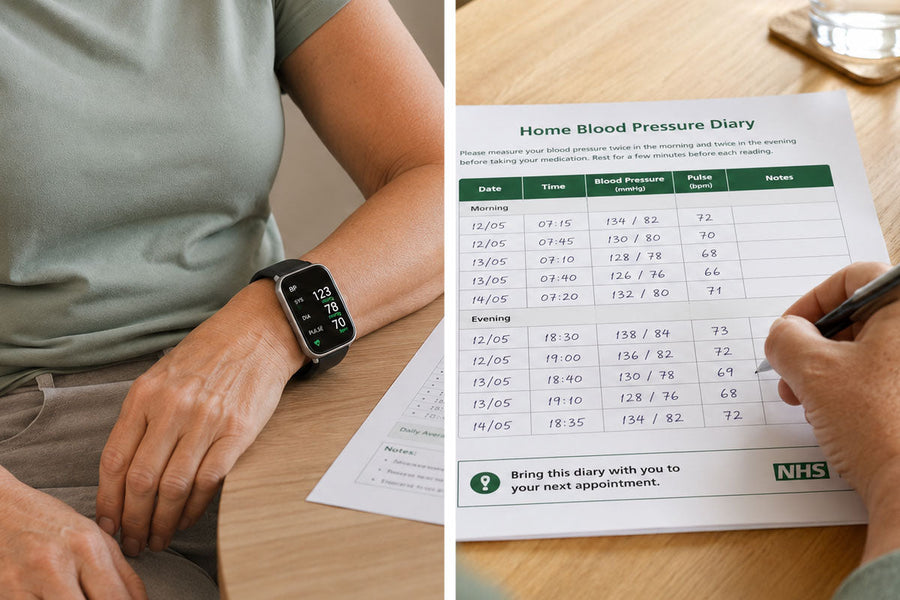
Most people assume that hot weather lowers blood pressure. For many, it does. But for the 14.4 million people in the UK living with hypertension, the picture is more complicated. Extreme heat can trigger acute spikes, disrupt the overnight BP dip cardiologists rely on, and amplify the effects of common medications, often within hours and entirely invisible to a single morning cuff reading. This article explains who is most at risk, what to do about it and how Hilo helps you see what is actually happening to your blood pressure during a heatwave.
Key facts
Der Artikel in 30 Sekunden- Over 14 million people in the UK are living with high blood pressure, and more than 70% haven’t measured it in the past month. Hilo BP Report UK 2025
- Extreme heat can push blood pressure in opposite directions: vasodilation lowers it, while dehydration and the stress response raise it, sometimes within the same day.
- Warm nights disrupt the normal nocturnal BP dip (a recognised cardiovascular risk marker) that a single daytime cuff reading will never capture.
- Common BP medications (diuretics, ACE inhibitors, beta-blockers) each interact with heat in distinct ways, amplifying both hypotension and dehydration risk. Hilo’s 24/7 monitoring helps you spot these changes.
Why heat and blood pressure have a complicated relationship
The relationship between temperature and blood pressure is not linear, and it does not affect everyone the same way. Two opposing mechanisms are at work simultaneously, and which one dominates depends on your individual cardiovascular profile.

The vasodilation effect: why heat often lowers blood pressure
When your body temperature rises, your blood vessels dilate. This is a deliberate cooling response: by expanding the vessels near the skin’s surface, the body pushes more warm blood outward to release heat. The result is a drop in peripheral vascular resistance, and with it, a fall in blood pressure.
Your heart compensates by beating faster. For most healthy adults, this is manageable. For people already taking antihypertensive medication, however, the additional vasodilation can push blood pressure too low, into territory where dizziness, falls and fainting become real risks. Stotz et al. (2014) note that high ambient temperatures decrease blood pressure in young and middle-aged adults, and that in older adults the additional drop on standing can lead to orthostatic hypotension, a sudden fall in blood pressure on standing.
The dehydration and stress response: why heat can also raise it
The vasodilation story is only half of it. As you sweat, your body loses fluid. Blood volume falls. In response, your kidneys activate the renin-angiotensin-aldosterone system (RAAS), a hormonal cascade that triggers vasoconstriction and fluid retention to restore pressure. The result is a rebound rise in blood pressure, even in the middle of a hot day.
Heat also elevates cortisol and other stress hormones, which add further upward pressure independently of fluid loss. A 2025 study published in the International Journal of Cardiology found that heatwave exposure was associated with acute blood pressure elevations in older individuals with hypertension, the opposite of what most patients expect.
Whether your blood pressure goes up or down in the heat depends on your individual cardiovascular profile. This is exactly why monitoring during heatwaves matters: the only way to know which direction your readings move is to measure them.
Who is most at risk during a heatwave?
Heat does not affect all blood pressure patients equally: some people suffer more than others during heatwaves. Four groups face elevated risk, and for different reasons.
| Group | Why the risk is higher | Key evidence | What goes undetected |
|---|---|---|---|
| People with hypertension | Heat triggers acute BP spikes as well as drops: the unpredictability itself is the risk | Zhang et al. (2025): acute BP elevation in elderly patients with hypertension during heatwave exposure | Transient spikes that resolve within hours, invisible to daily or weekly spot-checks |
| Older adults (65+) | Diminished thermoregulation leads to greater cardiovascular strain; orthostatic hypotension risk rises sharply | Stotz (2014, pilot study in 26 older women): heat exposure lowered BP and increased the orthostatic drop on standing; Aktiia optical device validated specifically in adults aged 65–88, including seated, standing and lying positions | Falls risk from sudden BP drop on standing, a position-specific measurement gap |
| People on BP medication | Diuretics accelerate dehydration; ACE inhibitors and ARBs reduce thirst sensation and compound vasodilation; beta-blockers impair the heart rate compensation that helps the body cool; ACE inhibitor + diuretic combination carries the highest risk | CDC Heat and Medications Guidance; Leach et al. (2025, PSU HEAT Project): ACE inhibitors, diuretics and beta-blockers can independently impair heat loss mechanisms | Medication-induced hypotension during peak heat hours, often attributed to the weather rather than the drug interaction |
| Anyone with disrupted nighttime BP | Heat disrupts sleep quality, which can elevate nocturnal BP even while daytime BP falls, producing or worsening a non-dipping or reverse-dipping pattern | Aktiia 24-hour study (Journal of Hypertension, 2025): nighttime SBP showed a clinically meaningful systematic difference versus ABPM reference; non-dipping pattern detectable with continuous monitoring | The nocturnal dip disappears; a morning cuff reading will never see it |
What happens to your readings during a heatwave?
The problem with standard blood pressure monitoring in summer is structural. A single cuff reading taken each morning captures one data point from a 24-hour window in which your BP may have shifted in multiple directions.
During a heatwave, readings typically diverge: daytime BP may fall due to vasodilation, while nighttime BP rises as disrupted sleep removes the normal overnight dip. Dehydration in the afternoon can trigger a RAAS-driven rebound spike that peaks in the evening and resolves by morning, entirely invisible to your usual measurement routine. And if you are on medication, these swings are amplified further.
According to the Hilo BP Report UK 2025 (which surveyed nearly 9,000 UK adults), more than 70% of people living with high blood pressure had not measured their BP in the past month. Nearly one in five had not measured in over two years. During a heatwave, this monitoring gap becomes a window in which significant changes can go undetected.
A clinically validated 24/7 monitoring system, by contrast, captures up to 25 automatic readings per day, including overnight insights, building a continuous picture that a single daily reading cannot provide. This does not replace a hospital ABPM assessment; it gives you continuous everyday data you can bring to that conversation with your GP.
What you can do: five practical steps
Managing blood pressure through a heatwave is not complicated, but it does require more than passive awareness. These five steps address both the physiological risks and the monitoring gap.
- Stay hydrated, proactively. Do not wait until you feel thirsty: by that point, you are already mildly dehydrated. The NHS and UKHSA recommend at least six to eight glasses of water daily in hot weather, more if you are outdoors or physically active. Adequate hydration keeps blood volume stable and reduces the likelihood of a RAAS-driven pressure rebound.
- Avoid the hottest part of the day. The UKHSA advises staying out of direct sun between 11am and 3pm during a heatwave. If you need to be outside, use shade, wear light loose clothing and carry water. The peak heat window is when vasodilation is most pronounced, and when medication interactions are most likely to cause dizziness or a fall.
-
Know how your medication behaves in the heat. This is the step most patients skip, and the one that matters most. Each major class of blood pressure medication interacts with heat differently:
- Diuretics: encourage fluid loss, which (combined with heavy sweating) can cause rapid dehydration, hypotension and, in severe cases, reduced kidney blood flow.
- ACE inhibitors and ARBs: reduce the body’s thirst sensation, meaning you may not drink enough to compensate for fluid loss. Their vasodilatory effect compounds the heat-driven drop in BP. The combination of an ACE inhibitor or ARB with a diuretic may significantly increase the risk of harm from heat exposure.
- Beta-blockers: reduce blood vessel dilation and impair the body’s ability to dissipate heat. They also suppress the compensatory heart rate rise the body uses as a cooling mechanism, reducing heat tolerance overall.
- Calcium channel blockers: can lead to decreased blood pressure, electrolyte imbalance and an increased risk of fainting and falls in the heat.
- Contact your GP if readings shift significantly. If your systolic BP drops persistently to 110 mmHg or below, or if you experience dizziness, lightheadedness, or near-fainting, contact your GP. Do not self-adjust doses. These symptoms may indicate that your medication dose needs reviewing for the summer months, but that review should happen with clinical guidance, not guesswork.
- Monitor continuously, not just once a day. A single morning reading gives you one data point from a 24-hour window that, in a heatwave, may include significant swings in both directions. Continuous monitoring lets you see the full picture: when your BP drops, when it spikes and whether your nighttime readings are rising while your daytime readings fall.
Can continuous monitoring change how you manage heat-related BP changes?
For people with hypertension, monitoring during a heatwave changes what you can actually do. Two features become particularly valuable in summer:
- Time in Target Range: instead of asking whether a single reading is high or low, it shows what proportion of your readings over a day or week fall within your target range. A heatwave week with significantly more time below range is actionable clinical information you can take straight to your GP.
- Nighttime BP profiling: hot nights disrupt sleep and can eliminate the normal nocturnal BP dip, a recognised cardiovascular risk marker. This pattern is only visible with overnight data; a morning cuff reading will never capture it.
Hilo measures your blood pressure automatically throughout the day and night. Key features include:
- 24/7 automatic monitoring: no manual readings required; the band measures continuously while you go about your day and sleep.
- Day and night profiles: see exactly how your BP changes between daytime and overnight, including dipping patterns.
- Time in Target Range: track what percentage of your readings fall within your target range across any time window.
- Doctor-ready reports: export a PDF report of your BP data to share directly with your GP.
The COOL-BP study, published in the American Journal of Hypertension (2025), found that 91% of patients preferred continuous cuffless monitoring over traditional home BP monitoring, and 79% used it every day, important in a heatwave, when motivation to pick up a cuff is at its lowest.
Your blood pressure doesn’t stop at 36°C
A once-a-day cuff reading can’t keep up with what heat does to your blood pressure. Hilo monitors automatically, day and night (30-35 readings a day), so you always have a fuller picture, whatever the weather.
Discover HiloOne thing to check before use: the Hilo Band isn’t intended for use during pregnancy, and people with certain implants or pre-existing conditions should check the product documentation or speak to their doctor first.
FAQ
Does heat lower or raise blood pressure?
Both, depending on the mechanism and the individual. Vasodilation caused by heat typically lowers blood pressure. But dehydration, the RAAS stress response and disrupted sleep can raise it, sometimes within the same day. People with hypertension are particularly vulnerable to the raising effect.
Should I take my blood pressure medication in hot weather?
Yes: do not stop or adjust your medication without speaking to your GP first. However, be aware that diuretics, ACE inhibitors, beta-blockers and calcium channel blockers each interact with heat in distinct ways. Monitor your readings closely during hot weather and flag significant changes to your doctor.
Is it normal for blood pressure to be lower in summer?
It is common, particularly in healthy adults, due to heat-induced vasodilation. However, it is not universal. People with hypertension may experience spikes rather than drops, and nighttime BP can rise even when daytime readings fall. If your summer readings seem unusually low or erratic, speak to your GP.
What is a dangerous blood pressure level in extreme heat?
A persistent systolic reading below 110 mmHg may indicate heat-induced hypotension, particularly if accompanied by dizziness or lightheadedness. Sustained high readings above your usual baseline during a heatwave are also worth discussing with your GP. Either pattern warrants a check-in, especially if you are on medication.
This article is for informational purposes only and does not constitute medical advice. If you have concerns about your blood pressure or how your medication may be affected by heat, please speak to a qualified healthcare professional. Do not adjust or stop any prescribed medication without medical guidance.
Sources
- J. Zhang; Y. Liu; H. Wang et al. (2025). Heatwaves induce blood pressure elevations in elderly patients with hypertension. International Journal of Cardiology, 432. https://doi.org/10.1016/j.ijcard.2025.132783
- T. P. De Almeida; D. Perruchoud; J. Alexandre; P. Vermare; J. Sola; J. Shah et al. (2025). Evaluation of Aktiia cuffless blood pressure monitor across 24-h, daytime, and night-time measurements versus ambulatory monitoring: a prospective, single-centre observational study. Journal of Hypertension, 43(4). https://doi.org/10.1097/HJH.0000000000003960
- O. Unlu; C. P. Cannon; S. Lee et al. (2025). Continual versus occasional blood pressure (COOL-BP) in remote hypertension management. American Journal of Hypertension, 38(5). https://pubmed.ncbi.nlm.nih.gov/39789184
- O. K. Leach; W. L. Kenney; L. A. Wrona et al. (2025). No effect of stage 1 hypertension or antihypertensive medication on critical environmental limits. Environmental Research, 275. https://pmc.ncbi.nlm.nih.gov/articles/PMC12301102/
- T. P. De Almeida; D. Perruchoud; J. Alexandre et al. (2023). Validation of the Aktiia blood pressure cuff for self-measurement in an adult population according to the ANSI/AAMI/ISO 81060-2:2013 standard. Blood Pressure Monitoring, 28(2), 89–95. https://journals.lww.com/bpmonitoring/fulltext/2023/04000/validation_of_the_aktiia_blood_pressure_cuff_for.6.aspx
- C. Sola; O. Stirnemann; J. Proenca et al. (2023). Performance of the Aktiia optical blood pressure measurement device in the elderly. Blood Pressure, 32(1). https://www.tandfonline.com/doi/full/10.1080/08037051.2023.2281320
- A. Stotz; K. Rapp; J. Oksa et al. (2014). Effect of a brief heat exposure on blood pressure and physical performance of older women living in the community—a pilot-study. International Journal of Environmental Research and Public Health, 11(12), 12623–12631. https://doi.org/10.3390/ijerph111212623
- Heat and medications — guidance for clinicians. Centers for Disease Control and Prevention. https://www.cdc.gov/heat-health/hcp/clinical-guidance/heat-and-medications.html (Accessed July 2026)
- Why some people suffer more than others during heatwaves. UKHSA Blog. https://ukhsa.blog.gov.uk/2025/07/10/why-some-people-suffer-more-than-others-during-heatwaves/ (Accessed July 2026)
- How does hot weather affect my heart? British Heart Foundation. https://www.bhf.org.uk/informationsupport/support/practical-support/weather-and-your-heart (Accessed July 2026)