The pharmacy shelf holds a dozen blood pressure monitors, and every box promises accuracy. Choosing one for yourself, or for a parent over 65, deserves better than guesswork: UK charities and NICE guidance both point to validated devices. This guide explains what to look for in a device, the age-specific points to raise with your GP, how to take home readings in the UK, and where cuffless systems fit.
Key facts at a glance
Der Artikel in 30 Sekunden- Validated first: UK guidance, including NICE, points to the BIHS list of independently validated monitors; an automatic upper-arm device is the recommended home choice.
- Fit and technique: the right cuff size and correct seated technique matter more than extra features; a practice nurse, GP or pharmacist can check both.
- Age-specific checks: an irregular pulse and dizziness on standing are two points to discuss with your GP before relying on home readings.
- Pattern visibility: Hilo, a certified medical device of band plus calibration cuff, shows blood pressure patterns between GP appointments alongside a validated cuff monitor.
What should you look for in a blood pressure monitor after 65?
For home use, UK charities such as Blood Pressure UK and the British Heart Foundation recommend an automatic (digital) monitor with an upper-arm cuff, because wrist and finger devices tend to give less reliable readings. If you are choosing a blood pressure monitor for the first time, that is the starting point.

Proven accuracy matters more than brand. The British and Irish Hypertension Society keeps a list of monitors that have passed independent validation, and UK guidance, including NICE, points to this list when a validated monitor is needed.
Next, the cuff. A cuff that is the wrong size can give an inaccurate reading. Measure around the middle of your upper arm, halfway between your shoulder and elbow, and check that the result falls within the range shown on the cuff or in the monitor’s instructions. If it does not, you may need to buy a different cuff size.
Finally, ease of use. Large displays, simple buttons and a clear memory function make daily readings easier, and a practice nurse, GP or pharmacist can check that the cuff fits and that you are using the monitor correctly.
Does an irregular heartbeat change which monitor you need?
Atrial fibrillation, a common type of irregular heartbeat, becomes more likely as you get older. It matters here because automatic monitors may not measure blood pressure accurately when the pulse is irregular, so NICE advises health professionals to check the pulse first and, if it is irregular, to measure blood pressure manually. We cover atrial fibrillation in more detail elsewhere.
This is not a ban on home readings. If you have atrial fibrillation, ask your GP whether they are suitable for you and how to take them. And an irregular-heartbeat alert on a home monitor is not a diagnosis, so mention it to your GP.
Important: If you have a fast or irregular heartbeat together with symptoms such as chest pain, shortness of breath, fainting or feeling dizzy, weakness or numbness on one side, or confusion or difficulty speaking, call 999, the NHS advises.
Why do standing readings matter more after 65?
Postural (orthostatic) hypotension is a fall in blood pressure when you stand up, and it becomes more relevant with age. NICE recommends checking for it if you have symptoms such as dizziness or falls, and in people with hypertension who are aged 80 or over or have type 2 diabetes.
The check itself is straightforward, but it is one for your GP or nurse, not something to carry out alone at home. During the check, your GP or nurse measures your blood pressure lying down, or seated if that is impractical, then again after you have been standing for at least 1 minute. A fall of at least 20mmHg systolic or 10mmHg diastolic indicates a significant postural drop.
Tell your GP if you feel dizzy on standing. Your GP or nurse can assess this and advise whether and how to repeat measurements at home, so raise it in the conversation about monitoring. If you have a significant postural drop or symptoms of postural hypotension, your treatment target should be based on your standing blood pressure.
How should you take home readings in the UK?
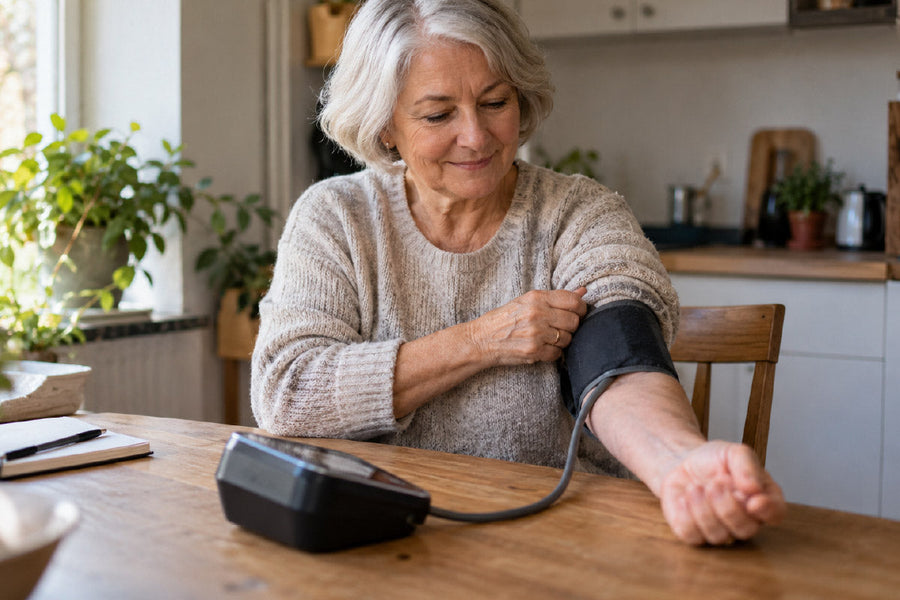
Good preparation makes home readings more reliable. Before each reading, sit quietly for five minutes with your back supported, your feet flat on the floor and your legs uncrossed, and rest your arm on a table so that it is at the level of your heart. If you are new to this, our guide on how to use a blood pressure monitor walks through the steps.
When home readings are used to confirm high blood pressure, NICE recommends a set schedule:
- Two seated readings, at least 1 minute apart, twice a day – ideally in the morning and evening.
- Continue for at least 4 days and ideally 7 days.
- The first day’s readings are discarded and the rest are averaged.
When high blood pressure is first being assessed, NICE also recommends measuring both arms: if the difference stays above 10mmHg, later readings are taken on the arm with the higher reading. Timing matters too, and our article on the best time to take blood pressure explains the morning and evening pattern.
Whatever your home readings show, do not stop or change your blood pressure medicine without talking to your GP first.
Important: Call 999 immediately if you have sudden chest pain that does not go away, pain spreading to your arm, neck, jaw, stomach or back, or chest pain with sweating, nausea, light-headedness or breathlessness. Also call 999 for suspected stroke, including sudden facial drooping, arm weakness or speech problems, even if the symptoms have now stopped. Do not delay the call to take another blood pressure reading. If you have no emergency symptoms but your systolic reading is 180mmHg or more, or your diastolic reading is 120mmHg or more, rest quietly for five minutes and check again. If it remains that high, seek medical advice that day from your GP surgery or the appropriate urgent-care service: NHS 111 in England or Wales, NHS 24 on 111 in Scotland, or your GP out-of-hours service in Northern Ireland. Frequent headaches, blurred vision or chest pain that comes and goes also warrant advice from your GP or local urgent-care service. Follow any lower contact threshold agreed with your GP.
What should your home readings be after 65 and after 80?
Two different questions hide inside 'what should my numbers be', and keeping them apart avoids confusion. The first is diagnosis. Under NICE guidance, high blood pressure is diagnosed when a clinic reading of 140/90mmHg or higher is confirmed by a daytime average of 135/85mmHg or higher from 24-hour ambulatory monitoring – or, if that is unsuitable or you cannot tolerate it, from an average of home readings. Either the top or the bottom number reaching the threshold is enough.
The second question is your treatment target, and here age plays a role. If you are being treated for high blood pressure, NICE recommends keeping your average home reading below 135/85mmHg if you are under 80, and below 145/85mmHg if you are 80 or over.
| Setting | Under 80 | 80 or over |
|---|---|---|
| Average home reading target | below 135/85mmHg | below 145/85mmHg |
| Clinic target | below 140/90mmHg | below 150/90mmHg |
The higher figures from 80 are treatment targets, not 'normal values for age', and NICE sets no separate threshold at 65. Your GP may set a different target if you live with frailty or several long-term conditions. For a wider view of how blood pressure changes across life, see our article on blood pressure by age.
Where do cuffless monitors fit for older adults?
Cuffless devices, worn on the wrist like a watch or band, measure without inflating a cuff. The evidence here comes with two caveats. Many cuffless devices need an initial calibration and regular recalibration against a cuff reading, and many smartwatches and fitness trackers that show a blood pressure value have not been independently validated for measuring blood pressure (J. B. Cohen et al., 2026; S. M. S. Islam et al., 2022). These concerns are not limited to uncertified consumer wearables. Regulatory certification and evidence of suitability for a particular clinical use are different questions. For diagnosis and treatment decisions, continue to use the validated cuff-based readings requested by your GP.
Tip: Do not confuse cuffless bands with validated wrist monitors. Some wrist monitors with a cuff have passed independent validation and can be an option if an upper-arm cuff is not possible for you, for example if your upper arm is very large (G. S. Stergiou et al., 2021). They are not interchangeable with an upper-arm monitor, and readings are only reliable when your wrist is held at the level of your heart. A cuffless band is a different category again.
Hilo is a certified medical device consisting of a wrist-worn band and a calibration cuff; it shows blood pressure patterns between GP appointments. It complements a validated upper-arm device and replaces neither a diagnosis nor 24-hour ambulatory measurement. If you want to see how Hilo works, the calibration cuff is part of the system: the band reveals the pattern, the cuff anchors it.
Hilo is not suitable for everyone over 65. Its current instructions for use cover ages 21 to 85 and exclude people with conditions including atrial fibrillation, diabetes and certain kidney or thyroid disorders. Check the full instructions before choosing the device.
The bottom line: a validated cuff first, convenience second
A validated upper-arm monitor with a cuff that fits and controls you can use comfortably comes first, and correct technique matters more than any extra feature. An irregular pulse and dizziness on standing are conversations to have with your GP. Once the basics are in place, a cuffless system such as Hilo can add pattern visibility between GP appointments, with its calibration cuff keeping those patterns anchored. Find out which blood pressure monitor suits you.
Ready to see your blood pressure pattern?
Hilo, a certified medical device of band plus calibration cuff, shows your blood pressure patterns between GP appointments, alongside a validated cuff monitor.
Discover the Hilo BandFAQ
What is a normal blood pressure for a 70-year-old in the UK?
NICE does not define 'normal' blood pressure by age. High blood pressure is diagnosed when a clinic reading of 140/90mmHg or higher is confirmed by a daytime average of 135/85mmHg or higher, from 24-hour ambulatory monitoring or an average of home readings. For treatment, NICE recommends keeping the average home reading below 135/85mmHg under 80, and below 145/85mmHg at 80 or over. These are treatment targets set with your GP.
Are wrist blood pressure monitors accurate for older people?
Some wrist monitors with a cuff have passed independent validation and can be an option if an upper-arm cuff is not possible for you, for example if your upper arm is very large. They are not interchangeable with an upper-arm monitor, and readings are only reliable when your wrist is held at the level of your heart. Cuffless bands without a cuff are a separate category, and many smartwatches showing a blood pressure value have not been independently validated.
Can a smartwatch measure blood pressure?
Many smartwatches and fitness trackers that show a blood pressure value have not been independently validated for measuring blood pressure. Many cuffless devices also need an initial calibration and regular recalibration against a cuff reading. A watch-shaped display is not a substitute for a validated monitor, and any device you rely on should be one your GP or pharmacist recognises as validated.
What if my home reading is very high?
With emergency symptoms – sudden chest pain, pain spreading to your arm, neck or jaw, or suspected stroke signs – call 999 immediately and do not delay the call to take another reading. If you have no emergency symptoms but your systolic reading is 180mmHg or more, or your diastolic reading is 120mmHg or more, rest quietly for five minutes and check again. If it remains that high, contact your GP or local urgent-care service for advice that day, and follow any lower contact threshold agreed with your GP.
The information in this article is for educational purposes only and does not replace medical advice. If you suspect you have high blood pressure or are concerned about your readings, speak to your GP or local urgent-care service. They can advise on the best next steps for your situation.
Sources
- J. B. Cohen et al. Cuffless devices for the measurement of blood pressure: a scientific statement from the American Heart Association. Hypertension. 2026;83:876–886. doi:10.1161/HYP.0000000000000254
- S. M. S. Islam; C. K. Chow; R. Daryabeygikhotbehsara et al. (2022). Wearable cuffless blood pressure monitoring devices: a systematic review and meta-analysis. Eur Heart J Digit Health, 3(2), 323-337. https://doi.org/10.1093/ehjdh/ztac021
- G. S. Stergiou; P. Palatini; G. Parati et al. (2021). 2021 European Society of Hypertension practice guidelines for office and out-of-office blood pressure measurement. J Hypertens, 39(7), 1293-1302. https://doi.org/10.1097/HJH.0000000000002843
- Hypertension in adults: diagnosis and management. NICE guideline NG136. https://www.nice.org.uk/guidance/ng136/chapter/recommendations (Accessed October 2026)
- Find a professional blood pressure monitor. British and Irish Hypertension Society. https://bihs.org.uk/blood_pressure_technology/find_a_professional_bp_monitor.aspx (Accessed October 2026)
- Monitoring your blood pressure at home. Blood Pressure UK. https://www.bloodpressureuk.org/your-blood-pressure/how-to-lower-your-blood-pressure/monitoring-your-blood-pressure-at-home/ (Accessed October 2026)
- How to measure your blood pressure at home. Blood Pressure UK. https://www.bloodpressureuk.org/your-blood-pressure/how-to-lower-your-blood-pressure/monitoring-your-blood-pressure-at-home/how-to-measure-your-blood-pressure-at-home/ (Accessed October 2026)
- How to choose a BP monitor. British Heart Foundation. https://www.bhf.org.uk/informationsupport/heart-matters-magazine/medical/tests/blood-pressure-measuring-at-home (Accessed October 2026)
- Atrial fibrillation. NHS. https://www.nhs.uk/conditions/atrial-fibrillation/ (Accessed October 2026)
- High blood pressure. NHS. https://www.nhs.uk/conditions/high-blood-pressure/ (Accessed October 2026)