

Wrist vs upper arm blood pressure monitors: what NHS guidance says, and where the Hilo Band fits
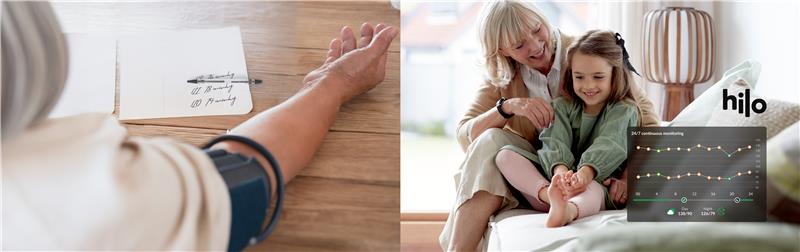
High blood pressure (BP) often has no symptoms, which is why the American Heart Association calls it 'the silent killer'. How and where you measure it shapes how far you can trust the numbers. This article explains what NHS and NICE guidance says about wrist vs upper arm blood pressure monitors, why wrist readings go wrong, and where a validated wrist-worn device like the Hilo Band fits.
Which blood pressure monitor
is really right for you?
Answer 6 short questions and get your personalised top 3 recommendation.
Key facts
- NICE guideline NG136 recommends home blood pressure monitoring to diagnose and manage hypertension; a home average of 135/85mmHg or higher is used to confirm a diagnosis.
- NHS England advises checking any home monitor against the BIHS validated-device list before you trust its readings.
- The American Heart Association recommends automatic upper-arm monitors for home use, not wrist or finger monitors, because wrist readings are more sensitive to body position.
- The European Society of Hypertension accepts cuff-based wrist monitors provided they are independently validated.
- The Hilo Band is a wrist-worn medical device, calibrated against a validated reference cuff.
What NHS and NICE guidance says about home blood pressure monitoring
Under NICE guideline NG136, home blood pressure monitoring (HBPM) is one of the two standard ways to confirm a hypertension diagnosis, alongside ambulatory blood pressure monitoring (ABPM), a cuff device worn for 24 hours. Neither NICE nor the NHS names a specific brand; instead, NHS England directs people to the BIHS validated-device list, the UK’s register of blood pressure monitors recommended for home use.
The guideline's key thresholds:
| Measurement | Threshold |
|---|---|
| Clinic BP confirming diagnosis | 140/90mmHg or higher |
| HBPM or ABPM daytime average confirming diagnosis | 135/85mmHg or higher |
| Clinic treatment target, adults under 80 | Below 140/90mmHg |
| Home treatment target, adults under 80 | Below 135/85mmHg |
| Clinic treatment target, adults 80 and over | Below 150/90mmHg |
| Home treatment target, adults 80 and over | Below 145/85mmHg |
The practical takeaway for a UK buyer: whatever sits on your wrist or your upper arm, check that it appears on a validated list before trusting its readings, and treat home monitoring as support for your GP alongside an NHS Health Check or an ABPM referral. If you are comparing specific models, our guide to the best home blood pressure monitors is a good starting point.
Wrist vs upper arm: why the guidance favours the upper arm
The American Heart Association recommends an automatic, cuff-style, upper-arm monitor for home blood pressure monitoring, and does not recommend wrist or finger monitors because they give less reliable readings. The reason is positional: a wrist device has to be held at heart level deliberately, and wrist readings are sensitive to exactly how the device is positioned.
The size of that error is well documented. Research from the ARMS crossover trial found that improper arm positioning alone can cause errors approaching 10mmHg. The standard protocol, endorsed by the AHA and the CDC, comes down to four rules:
- Sit quietly for at least five minutes before measuring.
- Support your arm at heart level.
- Keep your legs uncrossed.
- Use the same positioning every time, so readings are comparable.
Where a validated wrist device sits relative to the guidance
Wrist devices are not excluded from consideration. The European Society of Hypertension has recommended cuff-based wrist monitors, provided they are independently validated, and its consensus statement makes independent validation the decisive question for any wrist-worn device.
That splits the wrist category in two:
- Unvalidated consumer wearables – fitness trackers with BP claims but no medical-device validation.
- Validated wrist-worn medical devices – devices calibrated against a validated reference measurement and holding a medical-device registration, such as the Hilo Band. We draw this comparison in more detail in our piece on Hilo vs Whoop vs Apple Watch.
The Hilo Band is a CE-certified Class IIa medical device that is able to collect BP data passively, automatically, and is designed for long-term use.
How does the Hilo Band work?
The Hilo Band uses optical sensors to automatically measure BP when the in-built accelerometer notes that you have been still for long enough to collect a reliable measurement. Light is shone onto the skin to measure blood volume changes in vessels below the skin’s surface; as blood flows under higher or lower pressure, the proportion of light absorbed or scattered changes.
The system works in two phases:
- Setup: the first time you use the device, and then at monthly intervals, it is initialised: data collected by a Hilo cuff (provided with the subscription) are cross-referenced with data collected by the band, so the system takes your body’s physiology into account.
- Ongoing: the device collects dozens of measurements during each 24-hour period, creating a long-term overview of your BP’s trends and patterns. The app converts these into an easy-to-read dataset you can share with medical professionals.
How does the accuracy of the Hilo Band compare with a cuff?
The use of a cuff to measure BP is well-established, but it isn’t foolproof. Three documented sources of error:
- An incorrectly sized cuff can lead to incorrect readings in either direction: for patients who are obese, a cuff that is too small can overestimate BP and lead to medication that isn’t necessary, while underestimation can mean missed cases of hypertension.
- User error remains an issue even though people can buy and use cuffs at home.
- Home cuffs only provide a single measurement at one point in time – when a person remembers to perform the measurement.
Hilo, by contrast, gives a longer-term picture of BP, creating a personal dataset that reveals BP averages and trends. When assessing clinical and physiological aspects of health, many sequential data points of BP are required for optimal assessment, and that is exactly what Hilo provides. We cover the study evidence in detail in our guide to how accurate the Hilo Band is.
| Wrist cuff device | Upper arm cuff | Hilo Band | |
|---|---|---|---|
| Worn on | Wrist | Upper arm | Wrist |
| How it measures | Inflatable cuff at the wrist | Inflatable cuff | Optical sensor, calibrated against the Hilo cuff |
| Position in guidance | Only acceptable if independently validated | Preferred for home use (AHA); check the BIHS list | Wrist-worn medical device, calibrated with a validated reference cuff |
| What you get | Single spot checks | Single spot checks | Dozens of measurements across each 24-hour period |
The Hilo Band, if used correctly, can avoid the issues faced when using an inflatable cuff and provides rapid, regular blood pressure measurements that can be shared easily with medical professionals.
Hilo: registered as a medical device in the EU
To be registered as a medical device in the EU, as well as for submission to the FDA for approval in the US, the Hilo Band has undergone extensive clinical validation studies. In these tests, its performance was assessed against a reference gold-standard, with the full results published in Scientific Reports, a highly-respected peer-reviewed journal.
Across these trials, the bracelet's measurements were comparable with those from the reference device.
The bottom line
UK guidance puts independent validation first, the AHA recommends upper-arm monitors for home use, and the ESH accepts cuff-based wrist monitors that clear independent validation. The Hilo Band is not a cuff-based device: it is a wrist-worn medical device calibrated against a validated reference cuff, collecting dozens of readings across each 24-hour period. Bring whatever you measure to your GP; home data supports that conversation.
See your blood pressure patterns, not just snapshots
The Hilo Band collects dozens of readings a day, calibrated against a validated cuff, so your next GP conversation is backed by your real pattern.
Discover the Hilo BandOne thing to check before use: the Hilo Band isn’t intended for use during pregnancy, and people with certain implants or pre-existing conditions should check the product documentation or speak to their doctor first.
FAQ
Is a wrist blood pressure monitor as accurate as an upper arm cuff?
A correctly positioned, independently validated wrist device can produce reliable readings, and the European Society of Hypertension accepts cuff-based wrist monitors that clear that bar. The AHA still recommends upper-arm monitors for home use because wrist readings are more sensitive to body position, so the validation status of the specific device matters more than where it is worn.
What do NHS guidelines say about wrist blood pressure monitors?
NICE guideline NG136 recommends home blood pressure monitoring for diagnosis and ongoing care and points to devices on the BIHS validated list; it does not single out wrist devices. The practical NHS-endorsed test is whether the device is independently validated. What counts as a normal reading also depends on your age, which we cover separately in our guide to blood pressure by age.
Why is my blood pressure higher with a wrist cuff?
Usually positioning. An unsupported arm, or a wrist not held at heart level, can distort the result, and improper arm positioning alone can cause errors approaching 10mmHg. Sit quietly for at least five minutes, hold the wrist at heart level, then compare readings taken the same way on different days.
Can the Hilo Band replace an NHS ambulatory blood pressure monitor?
No. A 24-hour ambulatory monitor is a diagnostic test ordered by a clinician, and that remains the reference method. The Hilo Band is an everyday monitoring tool: it collects dozens of readings per day, including overnight, which can complement an ABPM assessment or prepare the conversation for one.
The information in this article is intended for educational purposes only and does not replace medical advice. If you suspect hypertension or are worried about your blood pressure, speak to your doctor. They can advise on the best way to effectively manage it.
Sources
- G. S. Stergiou; A. Menti; K. Asayama et al. (2026). Wearable wrist-watch type cuff oscillometric blood pressure monitors: consensus statement by the European Society of Hypertension Working Group on blood pressure monitoring. J. Hypertension, 44(10), 1721–1731. https://www.ovid.com/jnls/jhypertension/abstract/10.1097/hjh.0000000000004415~wearable-wrist-watch-type-cuff-oscillometric-blood-pressure
- H. Liu; D. Zhao; A. Sabit et al. (2024). Arm Position and Blood Pressure Readings: The ARMS Crossover Randomized Clinical Trial. JAMA Intern. Med., 184(12), 1436–1442. https://doi.org/10.1001/jamainternmed.2024.5213
- J. Ishigami; J. Charleston; E. R. Miller III et al. (2023). Effects of Cuff Size on the Accuracy of Blood Pressure Readings: The Cuff(SZ) Randomized Crossover Trial. JAMA Intern. Med., 183(10), 1061. https://doi.org/10.1001/jamainternmed.2023.3264
- J. Sola; A. Vybornova; S. Fallet et al. (2021). Validation of the optical Aktiia bracelet in different body positions for the persistent monitoring of blood pressure. Sci. Rep., 11, 20644. https://doi.org/10.1038/s41598-021-99294-w
- J. A. Hodgkinson; M.-M. Lee; S. Milner et al. (2020). Accuracy of blood-pressure monitors owned by patients with hypertension (ACCU-RATE study): a cross-sectional, observational study in central England. BJGP, 70(697), e548. https://doi.org/10.3399/bjgp20X710381
- Hypertension in adults: diagnosis and management (NG136). NICE. https://www.nice.org.uk/guidance/ng136/chapter/recommendations (Accessed October 2026)
- Find a professional blood pressure monitor. British and Irish Hypertension Society. https://bihs.org.uk/blood_pressure_technology/find_a_professional_bp_monitor.aspx (Accessed October 2026)
- Monitoring your blood pressure at home. American Heart Association. https://www.heart.org/en/health-topics/high-blood-pressure/understanding-blood-pressure-readings/monitoring-your-blood-pressure-at-home (Accessed October 2026)
- Measuring blood pressure. Centers for Disease Control and Prevention. https://www.cdc.gov/high-blood-pressure/measure/index.html (Accessed October 2026)
- When it comes to accurate blood pressure readings, cuff size matters. American Heart Association. https://www.heart.org/en/news/2022/03/01/when-it-comes-to-accurate-blood-pressure-readings-cuff-size-matters (Accessed October 2026)
- 4 big ways BP measurement goes wrong, and how to tackle them. American Medical Association. https://www.ama-assn.org/delivering-care/hypertension/4-big-ways-bp-measurement-goes-wrong-and-how-tackle-them (Accessed October 2026)
- Home blood pressure monitoring. National Health Service, UK. https://www.england.nhs.uk/ourwork/clinical-policy/cvd/home-blood-pressure-monitoring/ (Accessed October 2026)
- 24-Hour Ambulatory Blood Pressure Monitoring. Cleveland Clinic. https://my.clevelandclinic.org/health/diagnostics/16330-24-hour-ambulatory-blood-pressure-monitoring (Accessed October 2026)
Read more

Learn how walking can help lower blood pressure, reduce hypertension risk, and support heart health. See how many steps to aim for and how Hilo can help.

Can cannabis help with high blood pressure – or does it do more harm than good? While some studies point to possible positive effects, doctors warn of risks to the heart and circulatory system. Th...

Learn what to look for when buying a home-use blood pressure monitor