

An Apple a Day Keeps the Doctor Away: Does Cider Vinegar Lower BP?
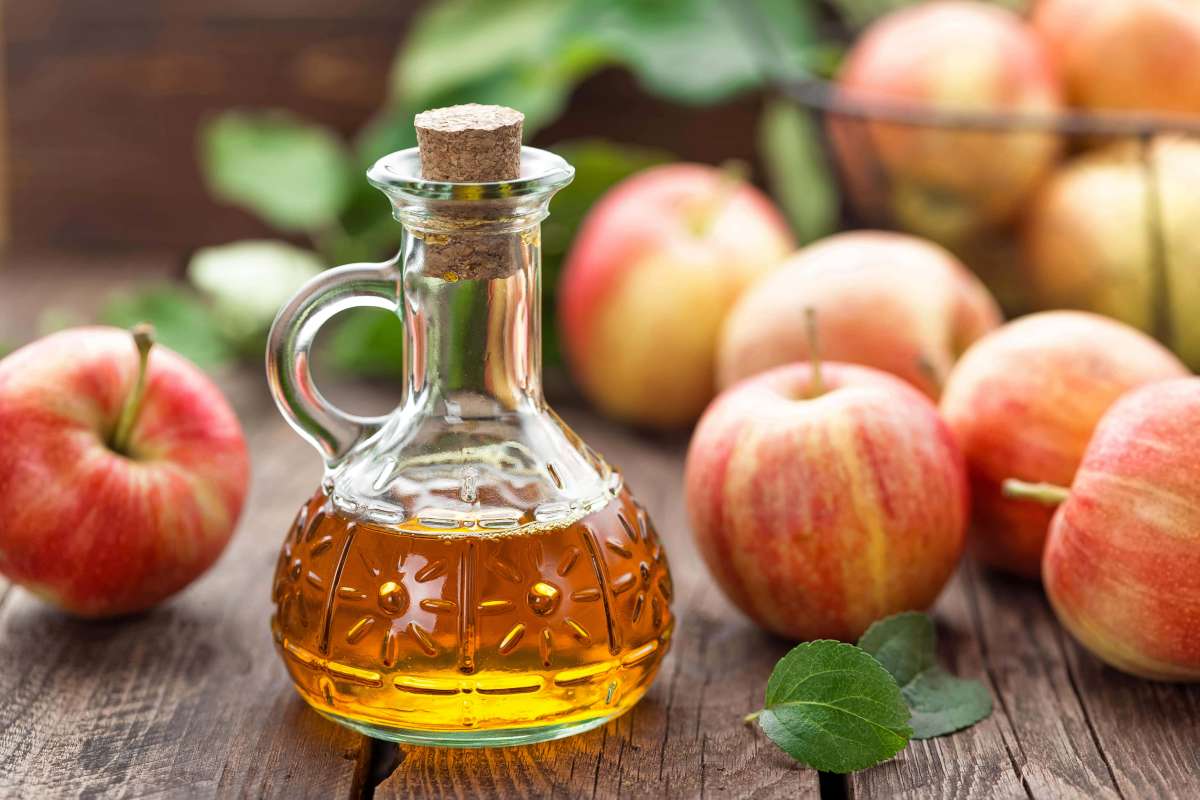
Apple cider vinegar has been touted as a treatment for hypertension, with those following this advice taking in the region of 15 mL, (around 1 tablespoon or 3 teaspoons) once per day. But is there any truth to this claim, or is it just urban legend?
What is apple cider vinegar?
Apple cider vinegar (or ACV) is made from the fermentation of apples and can be prepared at home. Production effectively relies upon apples being placed in water so the sugars in them break down through a two-stage pathway. In the first stage, the fruit sugars are subjected to glycolysis (breaking down) by yeasts, such as Saccharomyces cerevisiae, to form ethanol (alcohol). The second stage involves oxidation, during which the ethanol is converted into acetic acid (vinegar) by a species of acetobacter, such as Acetobacter aceti.
Apple cider vinegar can be sold as either filtered (clear) or unfiltered and unpasteurised (cloudy). It’s the latter version that’s said to have health benefits, due to the presence of ‘good bacteria’, sometimes referred to as the ‘mother culture’.
What are the reported benefits?
The use of apple cider vinegar for health treatments has been established for millennia. Initially believed to have been discovered by a courtier in Babylonia in 2000 BCE, Hippocrates – the founder of medicine as a science – was thought to be using vinegar to heal wounds in around 420 BCE, although this is no longer recommended (for obvious reasons). In later years, vinegar was seen as a cure for many ailments, from oedema (swelling) to stomach ache, and even croup. However, while vinegar seemed to have often been used topically (on the skin), modern advocates suggest taking it as a dilute solution in water.
What about using it for blood pressure?
The evidence that ACV can reduce blood pressure is very limited, and mainly confined to decade-old trials in rats. In 2001, Kondo and co-workers reported a reduction in blood pressure of spontaneously hypertensive rats that were fed a diet of acetic acid (the main component in vinegar), as well as a reduction in renin activity, to which was attributed the reduction in BP (renin is used in the Renin-Angiotensin-Aldosterone System (RAAS) that controls BP, among other things). Other studies have suggested that vinegar may inhibit the angiotensin-converting enzyme, ACE, in rats, but more research is needed. (Side note: this is a similar mode of action to a type of antihypertensive medication used in humans, so there is merit to this argument). However, human trials are lacking, and when they have been undertaken, they have severe limitations.
Can I use apple cider vinegar for other health issues?
While the jury’s still out on the use of apple cider vinegar to lower blood pressure, there are some medical conditions where its use may be beneficial. For example, consumption of ACV by patients with type 2 diabetes was shown to lower cholesterol and blood glucose in a 2021 meta-analysis and in a 2023 study, but both had limitations and again, further investigation is needed to draw concrete conclusions.
When it comes to weight loss, the picture is also unclear. While some studies claim that consumption of vinegar can aid weight management, others state that there is insufficient evidence.
Finally, apple cider vinegar has been suggested to aid good gut health, as with many other fermented foods. The idea is that fermented foods promote formation of a diverse gut microbiome, which then has positive consequences for overall body health. Deviation from the norm in this fragile environment has been associated with many diseases, including obesity, type 2 diabetes, hepatic steatosis (fatty liver disease), intestinal bowel diseases (IBDs) and several types of cancer. However, ACV-specific evidence is lacking, and further investigation is required.
Are there any risks to drinking apple cider vinegar?
It should be noted that vinegar is an acid, therefore ingesting it means there is a risk of damaging tooth enamel and causing throat burns (so make sure to keep it away from children). In addition, because of its acidic nature, the risk of acid reflux (heartburn) is also increased. If you do decide to consume ACV, remember to limit your intake to a maximum of 30 mL/day. It’s also a good idea to dilute it in water, use a straw, and rinse your mouth after taking it to limit enamel damage.
The take home
The evidence around the consumption of apple cider vinegar as a tool to reduce blood pressure is patchy at best, and entirely missing at worst. Its use in treating other health conditions, such as lowering cholesterol, aiding weight management, and improving gut health is also limited. While there are very few known adverse effects from taking apple cider vinegar, application onto the skin could cause burns, and consuming too large a quantity in the long term could be dangerous. ACV is, after all, a form of acid, and could disrupt your body’s pH, leading to mineral depletion and lower bone density as your body tries to regain balance. If you suffer from hypokalemia (low potassium in the blood) it may be best to avoid it. There is also a risk that it could interact with some medicines, such as diuretics for hypertension treatment and insulin.
This article is for informational purposes only and does not contain nor replace medical advice. The information in this article is not intended to diagnose, treat, cure, or prevent any disease. Talk to a qualified medical professional before making any changes to your health regimen.
FAQs
Sources
How to make apple cider vinegar. 7th November 2020. Guardian, UK. https://www.theguardian.com/lifeandstyle-how-to-make-apple-cider-vinegar
The Metabolic Pathways of Yeast and Acetic Acid Bacteria During Fruit Vinegar Fermentation and Their Influence on Flavor Development (2025). Y. Ge, Y. Wu, A. Aihaiti et al., Microorganisms, 13, 477. https://doi.org/10.3390/microorganisms13030477
Vinegar: Medicinal Uses and Antiglycemic Effect (2006). C. S. Johnston, C. A. Gaas, MedGenMed, 8, 61. https://pmc.ncbi.nlm.nih.gov/articles/PMC1785201/
Hippocrates of Kos (460-377 BC): The Founder and Pioneer of Clinical Medicine (2024). N. A. Kostakopoulos, T. C. Bellos, S. Katsimperis, L. Tzelves, Cureus, 16, e70602. https://doi.org/10.7759/cureus.70602
Antihypertensive Effects of Acetic Acid and Vinegar on Spontaneously Hypertensive Rats (2001). S. Kondo, K. Tayama, Y. Tsukamoto et al., Biosci. Biotechnol. Biochem., 65, 2690. https://doi.org/10.1271/bbb.65.2690
Renin-Angiotensin-Aldosterone System (RAAS). Cleveland Clinic. https://my.clevelandclinic.org/health-articles-renin-angiotensin-aldosterone-system-raas (Accessed May 2026)
A Red Wine Vinegar Beverage can Inhibit the Renin-Angiotensin System: Experimental Evidence in Vivo (2005). S. Honsho, A. Sugiyama, A. Takahara et al., Biol. Pharm. Bull., 28, 1208. https://doi.org/10.1248/bpb.28.1208
Angiotensin-converting enzyme (ACE) inhibitors. Mayo Clinic. https://www.mayoclinic.org/diseases-conditions/high-blood-pressure/in-depth/ace-inhibitors/art-20047480 (Accessed May 2026)
The effect of apple cider vinegar on lipid profiles and glycemic parameters: a systematic review and meta-analysis of randomized clinical trials (2021). A. Hadi, M. Pourmasoumi, A. Najafgholizadeh et al., BMC Complement. Med. Ther., 21, 179. https://doi.org/10.1186/s12906-021-03351-w
The improvement effect of apple cider vinegar as a functional food on anthropometric indices, blood glucose and lipid profile in diabetic patients: a randomized controlled clinical trial (2023). S. Jafarirad, M.-R. Elahi, A. Mansoori et al., 4. https://doi.org/10.3389/fcdhc.2023.1288786
Effect of Apple Cider Vinegar Intake on Body Composition in Humans with Type 2 Diabetes and/or Overweight: A Systematic Review and Meta-Analysis of Randomized Controlled Trials (2025). A. Castagna, Y. Ferro, F. R. Noto et al., Nutrients, 17, 3000. https://doi.org/10.3390/nu17183000
Safety and side effects of apple vinegar intake and its effect on metabolic parameters and body weight: a systematic review (2020). T. L. Launholt, C. Blanner Kristiansen, P. Hjorth, Eur. J. Nutr., 59, 2273. https://doi.org/10.1007/s00394-020-02214-3
Gut microbiome and health: mechanistic insights (2022). W. M. de Vos, H. Tilg, M. Van Hul, P. D. Cani, Gut, 71, 1020. https://doi.org/10.1136/gutjnl-2021-326789
Steatotic (Fatty) Liver Disease. Cleveland Clinic. https://my.clevelandclinic.org/health/diseases/15831-fatty-liver-disease (Accessed May 2026)
Apple Cider Vinegar Dosage: How Much Should You Drink per Day? Healthline. https://www.healthline.com/nutrition/apple-cider-vinegar-dosage (Accessed May 2026)
Your pH balance and your bones. National Osteoporosis Foundation South Africa. https://osteoporosis.org.za/your-ph-balance-and-your-bones (Accessed May 2026)
7 Side Effects of Too Much Apple Cider Vinegar. Healthline. https://www.healthline.com/nutrition/apple-cider-vinegar-side-effects (Accessed May 2026)
Drinking apple cider vinegar for weight loss seems far-fetched. Does it work? Mayo Clinic. https://www.mayoclinic.org/healthy-lifestyle/weight-loss/expert-answers/apple-cider-vinegar-for-weight-loss/faq-20058394 (Accessed May 2026)
Heart-smart families: Fighting back against high blood pressure. Hilo. https://hilo.com/en-gb/blogs/art/heart-smart-families-fight-high-blood-pressure (Accessed May 2026)
Hilo Band. Hilo. https://hilo.com/en-gb (Accessed May 2026)
Read more

Garlic has long been touted a treatment for lowering blood pressure in hypertensive individuals, but is there any truth in this claim? This short article will examine the evidence, and provide an a...

Learn how walking can help lower blood pressure, reduce hypertension risk, and support heart health. See how many steps to aim for and how Hilo can help.

Can cannabis help with high blood pressure – or does it do more harm than good? While some studies point to possible positive effects, doctors warn of risks to the heart and circulatory system. Th...

About the medical reviewer
Dr Sarah Skennerton
GP, United Kingdom