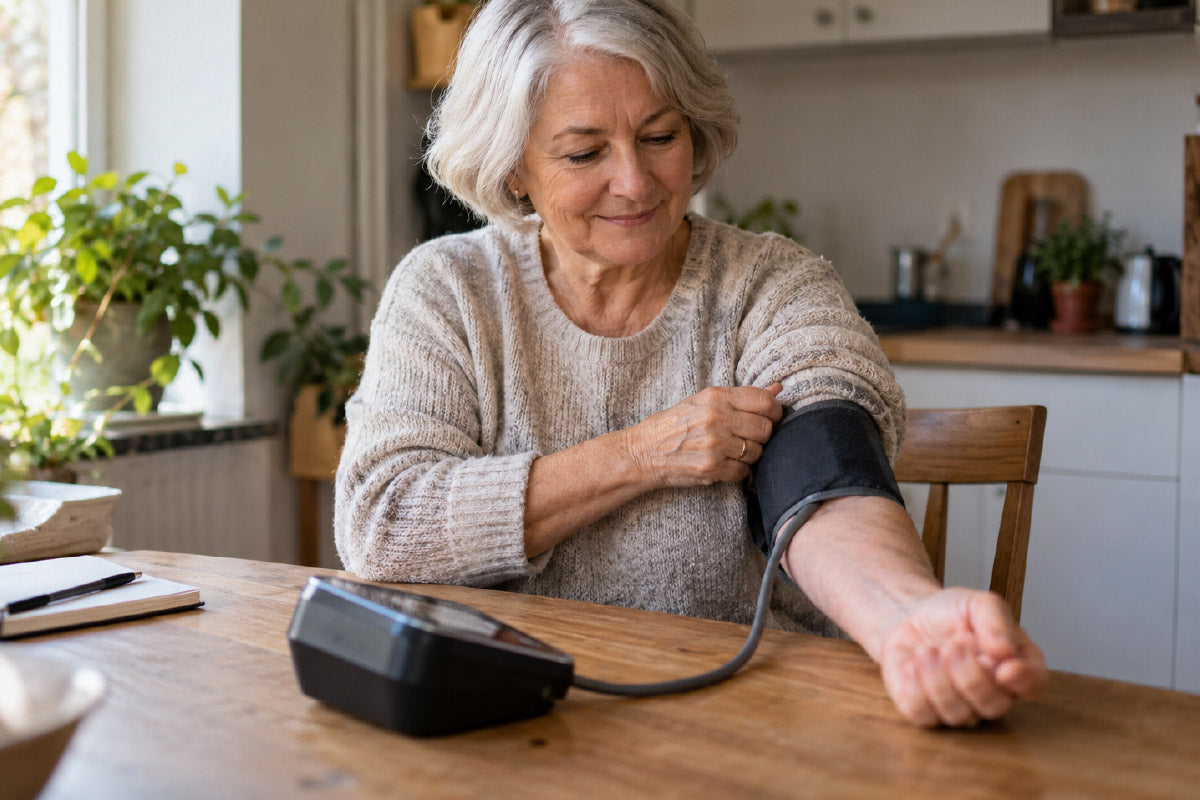
Your GP has asked you to record your blood pressure at home, and one practical question follows straight away: does the NHS give you a blood pressure monitor, or do you have to buy your own? This guide explains the common NHS routes to a monitor and a free check, why your GP asks for home readings, and what matters when you choose a device of your own. This article explains common NHS routes, with the pharmacy blood pressure check service and NHS Health Check described below applying to England. Arrangements elsewhere in the UK can differ. Your GP practice or local NHS service can explain what is available.
Key facts at a glance
The article in 30 seconds- Loan, not automatic: Your GP practice may lend you a monitor for home readings; the NHS does not automatically supply one, and a 24-hour ABPM device is returned after the test.
- Free checks exist: In England, participating pharmacies offer a free NHS blood pressure check, and eligible adults aged 40 to 74 are invited to an NHS Health Check roughly every five years.
- Why home readings: Under NICE guidance, home or 24-hour readings confirm a diagnosis because clinic readings alone can mislead; hypertension is confirmed at a home average of 135/85mmHg or more.
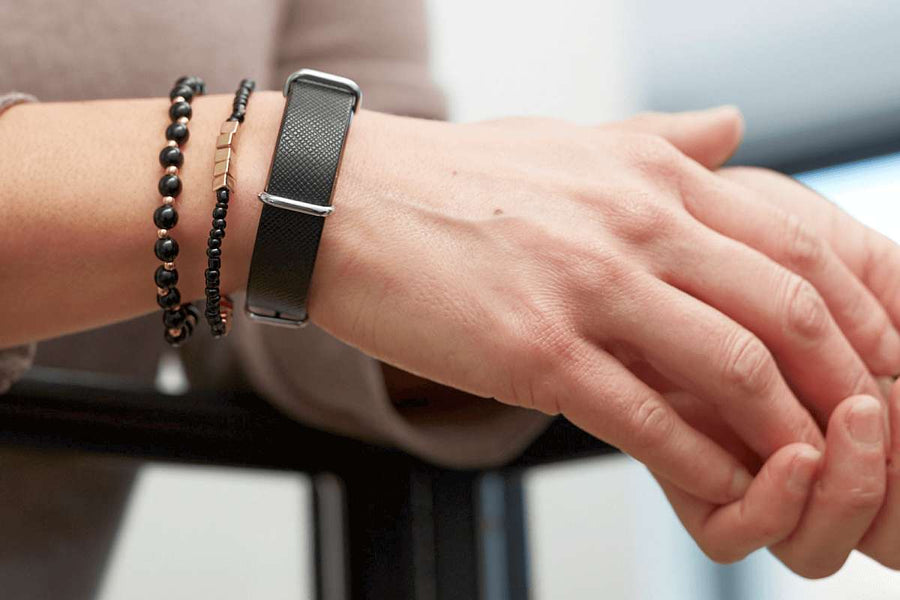
- Buying your own: Choose a clinically validated model; the Hilo Band, a certified medical device worn on the wrist with a calibration cuff, shows your blood pressure pattern between appointments.
Does the NHS give you a blood pressure monitor?
Sometimes, and it depends on your practice and on why you need one. Your GP practice may be able to lend you a monitor if you are asked to record your blood pressure at home. Ask the practice what is available locally and when any loaned device must be returned. You may otherwise need to buy your own monitor.
The device used for a 24-hour ambulatory blood pressure monitoring (ABPM) test is a different case. It is returned afterwards and is not a home monitor to keep.
Good to know: Some GP practices also offer services such as BP@Home. Your practice explains how to take and submit readings and when they will be reviewed. This does not mean a monitor is automatically supplied or that they are watched continuously. Ask how to seek help with urgent readings. NHS England has supported home monitoring through the Blood Pressure @home initiative, with services delivered locally; NHS Essex ICB is one example. Access to support and equipment varies, so ask your GP practice what is available in your area.
Where can you get your blood pressure checked for free?
In England, participating pharmacies offer free NHS blood pressure checks, usually for people aged 40 or over who have not been diagnosed with hypertension and have not had their blood pressure checked in the past five years (NHSBSA; NHS). Some younger people at increased risk may also qualify. Ask the pharmacy to check your eligibility. If a check shows high blood pressure, the pharmacist may offer ambulatory blood pressure monitoring (ABPM): you wear the monitor, usually for 24 hours, and then return it. The results are shared with your GP practice to confirm the diagnosis and agree any treatment. Very high readings require urgent medical assessment.
There is also the NHS Health Check: in England it is generally offered every five years to eligible adults aged 40 to 74 and includes a blood pressure check (NHS). If you need home monitoring, ask your practice separately about borrowing a device. People already diagnosed with conditions such as hypertension should receive follow-up through their usual care instead.
Free checks matter because owning a device is not the same as using one. Hilo’s UK BP Report 2025 includes an online survey of 2,000 people aged 16 and over. Around 47% said they had heard of ’hypertension’ and knew what it meant. The report also describes a gap between monitor ownership and use: nearly half of households owned a monitor, while about a quarter of respondents who reported the location of their last blood pressure measurement said it was taken at home.
Why might your GP ask for home readings?
A reading taken in the surgery captures your blood pressure in one moment. Under NICE guidance, home or 24-hour readings are used to confirm what a clinic measurement suggests, because clinic readings alone can mislead. Diagnosis thresholds, treatment targets and action thresholds for very high readings are three different things, and it helps to keep them apart.
How home readings confirm a diagnosis
Under NICE guideline NG136, a clinic blood pressure of at least 140/90mmHg but below 180/120mmHg should usually be checked with ABPM to confirm the diagnosis. Home monitoring is offered if ABPM is unsuitable or cannot be tolerated. Hypertension is confirmed when the raised clinic blood pressure is accompanied by an ABPM daytime average or a home average of at least 135/85mmHg. A systolic clinic reading of 180mmHg or more, or a diastolic reading of 120mmHg or more, needs a more urgent clinical assessment.
If you are being treated for high blood pressure, NICE recommends keeping your average home reading below 135/85mmHg if you are under 80, or below 145/85mmHg if you are 80 or over. Your GP or nurse will explain what your own target is.
How to measure at home, according to NICE
To confirm a diagnosis with home monitoring, NICE recommends a simple routine (NICE; NHS):
- Take 2 readings at least 1 minute apart while seated.
- Measure twice a day, ideally in the morning and the evening.
- Continue for at least 4 days and ideally 7 days.
- Discard the readings from the first day and use the average of the rest.
Your doctor or nurse will tell you how many days to take readings for, so follow their instructions. If you are new to a device, our guide on how to use a blood pressure monitor covers the practical basics.
Important: If you have symptoms of a heart attack or stroke, call 999 immediately, whatever the reading. Do not wait to measure again. If you feel well but your systolic reading is 180mmHg or more or your diastolic reading is 120mmHg or more, rest quietly for five minutes and repeat it. If it remains that high, seek medical advice that day from your GP surgery or the appropriate urgent-care service: NHS 111 in England or Wales, NHS 24 on 111 in Scotland, or your GP out-of-hours service in Northern Ireland. Follow any lower contact threshold agreed with your practice (NICE; NHS).
What are your options if you buy your own monitor?
Whichever monitor you choose, make sure it has been clinically validated. The British and Irish Hypertension Society (BIHS) keeps a list of validated blood pressure monitors for home use, and NICE points to this list in its guidance. Check that the exact model name is on the list.
Tip: If you want more than individual readings, Hilo is one option to consider. It is a certified medical device: the wrist-worn band estimates blood pressure during periods of rest, using optical signals and calibration with the supplied upper-arm cuff. Over time it shows your blood pressure pattern.
For home use, an automatic monitor with an upper-arm cuff is generally recommended, as wrist and finger monitors tend to give less reliable readings (Blood Pressure UK; BHF; G. S. Stergiou et al., 2021). If an upper-arm cuff does not work for you, a validated wrist-cuff monitor can be an option.
Where Hilo fits
The Hilo system consists of the Hilo Cuff, a validated and NHS listed upper-arm cuff, and the Hilo Band, which enriches the cuff readings with blood pressure estimates during periods of rest throughout the day, so your pattern becomes visible between appointments. Hilo complements a validated upper-arm device. It replaces neither the 24-hour ABPM test nor the home readings your GP asks for to confirm a diagnosis. The band is intended for ages 21 to 85. It is not intended for people with, among others, atrial fibrillation, diabetes, or certain kidney or thyroid conditions; check the complete usage limits in the instructions for use and speak to your doctor if any of these apply to you. In the UK, Hilo costs £199.98 in the first year (£79.99 band + £119.99 annual subscription).

For a wider walk-through of device types and what the NHS and NICE point towards, see our UK buying guide to choosing a blood pressure monitor.
The bottom line
The NHS does not automatically give you a blood pressure monitor, but there are real routes: a practice loan, remote-monitoring support such as BP@Home, free pharmacy checks and the NHS Health Check in England, and the 24-hour ABPM your GP or pharmacist can arrange. If you buy your own, clinical validation is the non-negotiable.
If you want to see your pattern between appointments rather than isolated numbers, Hilo is one option to discuss with your GP.
FAQ
Can I keep the 24-hour blood pressure monitor the NHS gives me?
No. A device supplied for a 24-hour ABPM test is returned afterwards; it is not a home monitor to keep. If you still need to record your blood pressure, ask your GP practice about borrowing a device or expect to buy your own validated monitor.
What home blood pressure reading confirms high blood pressure?
Under NICE guidance, hypertension is confirmed when a raised clinic reading is accompanied by a home average of at least 135/85mmHg (or an ABPM daytime average at the same level). If you are already being treated, the aim is different: NICE recommends keeping your average home reading below 135/85mmHg if you are under 80, or below 145/85mmHg if you are 80 or over. Your GP or nurse will confirm your own target.
Are wrist blood pressure monitors accurate?
Wrist and finger monitors tend to give less reliable readings than automatic monitors with an upper-arm cuff, which is why an upper-arm cuff is generally recommended for home use. If an upper-arm cuff does not work for you, for example because your arm is very large, a validated wrist-cuff monitor can be an option. Whatever you choose, check the exact model on the BIHS list of validated devices.
How often should you replace a home blood pressure monitor?
The BIHS advises replacing a home blood pressure monitor after a maximum of four years of use. Do so sooner if it is damaged, particularly the cuff, or if you are worried that it is no longer accurate. This is practical advice from a professional society, so it is worth checking your device regularly.
Disclaimer: The information in this article is for educational purposes only and does not replace medical advice. If you suspect you have high blood pressure or are concerned about your readings, speak to your GP or local urgent-care service. They can advise on the best next steps for your situation.
Sources
- G. S. Stergiou; P. Palatini; G. Parati et al. (2021). 2021 European Society of Hypertension practice guidelines for office and out-of-office blood pressure measurement. Journal of Hypertension, 39(7), 1293-1302.
https://research.dial.uclouvain.be/server/api/core/bitstreams/b37ef7a1-70a2-49d3-89f5-8f101c30b4f1/content - Hypertension in adults: diagnosis and management, NICE guideline NG136 recommendations. National Institute for Health and Care Excellence.
https://www.nice.org.uk/guidance/ng136/chapter/recommendations
(Accessed October 2026) - NHS Community Pharmacy Blood Pressure Check Service. NHS Business Services Authority.
https://www.nhsbsa.nhs.uk/pharmacies-gp-practices-and-appliance-contractors/dispensing-contractors-information/nhs-community-pharmacy-blood-pressure-check-service
(Accessed October 2026) - Find a pharmacy that offers free blood pressure checks. NHS.
https://www.nhs.uk/nhs-services/pharmacies/find-a-pharmacy-that-offers-free-blood-pressure-checks/
(Accessed October 2026) - Blood pressure test. NHS.
https://www.nhs.uk/tests-and-treatments/blood-pressure-test/
(Accessed October 2026) - High blood pressure. NHS.
https://www.nhs.uk/conditions/high-blood-pressure/
(Accessed October 2026) - NHS Health Check. NHS.
https://www.nhs.uk/tests-and-treatments/nhs-health-check/
(Accessed October 2026) - BP@Home. NHS Essex Integrated Care Board.
https://www.essex.icb.nhs.uk/health/prevention/live-well/cardiovascular-health/blood-pressure/bp-at-home/
(Accessed October 2026) - Validated blood pressure monitors. British and Irish Hypertension Society.
https://bihs.org.uk/blood_pressure_technology/find_a_professional_bp_monitor.aspx
(Accessed October 2026) - Monitoring your blood pressure at home. Blood Pressure UK.
https://www.bloodpressureuk.org/your-blood-pressure/how-to-lower-your-blood-pressure/monitoring-your-blood-pressure-at-home/
(Accessed October 2026) - How to choose a blood pressure monitor. British Heart Foundation.
https://www.bhf.org.uk/informationsupport/heart-matters-magazine/medical/tests/blood-pressure-measuring-at-home
(Accessed October 2026)